

.png.png)


Why AI Matters in Beauty & Wellness Mobile Apps Today
AI in Beauty & Wellness Mobile App Development is no longer about experimentation; it is becoming the foundation of how modern beauty and wellness platforms are designed, scaled, and monetised.
In the beauty and wellness industry, user expectations are fundamentally different from those of generic consumer apps. People are not just browsing content; they are looking for guidance, results, and trust. Whether it’s skincare, haircare, fitness, or mental wellness, users expect mobile apps to adapt to their individual needs rather than offer static, one-size-fits-all experiences. This is where AI becomes essential.
From a product perspective, AI allows beauty and wellness mobile apps to move beyond simple feature sets into intelligent systems. Instead of manual questionnaires or rigid filters, AI-driven logic can analyse behaviour, preferences, progress, and outcomes over time. This transforms the app from a digital catalogue into a smart assistant that evolves with the user.
For businesses, AI changes the economics of custom mobile app development in beauty and wellness. Personalisation at scale is almost impossible to maintain manually. AI-powered models automate recommendations, routines, and content delivery while keeping experiences highly individual. This makes AI not just a user-experience upgrade, but a scalability enabler, especially for brands building subscription-based or platform-style products.
In many modern projects, beauty and wellness apps are built as SaaS platforms rather than standalone mobile products. This is where SaaS application development services intersect with AI adoption. AI-driven features such as diagnostics, recommendations, and progress tracking are often shared across mobile apps, admin dashboards, and backend systems, forming a unified SaaS ecosystem.
Another key reason AI matters today is data maturity. Beauty and wellness brands now collect vast amounts of structured and behavioural data: product usage, routine adherence, session frequency, visual inputs, and feedback loops. Without AI, this data remains underutilised. With AI, it becomes a competitive asset that informs product decisions, improves retention, and drives long-term value.
From the perspective of a SaaS development company, AI is no longer an optional layer added after launch. It increasingly shapes the core architecture of beauty and wellness mobile apps from day one. Especially in SaaS MVP development, AI helps validate product hypotheses faster by learning directly from real user behaviour.
In short, AI matters in beauty and wellness mobile apps today because it aligns technology with how users actually think, behave, and change over time. For companies investing in custom mobile app development, AI is the difference between building a functional app and creating a scalable, intelligent digital product that grows with its audience.
Personalisation and User Experience Mechanics in Beauty & Wellness Mobile Apps
In beauty and wellness mobile apps, AI-driven personalisation works through concrete UX mechanics embedded directly into everyday user interactions. These mechanics define how the app reacts to behaviour in real time and how individual experiences diverge over time, even for users with similar starting profiles.
Behaviour Signals as the Core Input
In AI-driven beauty and wellness app development, personalisation relies on continuous behavioural signals rather than static profiles or one-time onboarding data.
Key signals include:
-
routine completion and abandonment patterns;
-
repeated skips of specific steps;
-
time spent on actions or screens;
-
session frequency and timing.
These signals allow custom mobile app development in beauty and wellness to adapt flows automatically, without requiring users to manually adjust preferences.
Adaptive Content and Flow Logic
AI personalisation directly affects how content and user flows are structured inside beauty and wellness mobile apps. Instead of fixed sequences, the system dynamically adjusts ordering, pacing, and emphasis.
Examples include:
-
reordering routine steps when friction is detected;
-
shortening flows when drop-off probability increases;
-
surfacing guidance only when usage patterns indicate relevance.
This logic operates beneath the interface, keeping the UX familiar while behaviour adapts.
Context-Aware Timing in Wellness Experiences
In AI-powered wellness mobile apps, timing is as important as content. AI systems optimise when interactions occur based on established usage rhythms.
Typical adjustments include:
-
scheduling reminders when engagement likelihood is highest;
-
suppressing notifications during low-response periods;
-
aligning prompts with habitual usage windows.
These changes reduce interruption and improve perceived relevance without introducing new UI complexity.
Modular Routines in Beauty & Wellness Apps
In beauty and wellness app development, routines are treated as modular systems rather than static checklists. Each step can be independently included, excluded, or reordered.
This enables:
-
gradual progression in routine complexity;
-
conditional steps based on previous outcomes;
-
temporary adjustments without resetting the entire flow.
Such flexibility is only achievable through custom mobile app development, where AI logic is tightly integrated with UX architecture.
UX Control and Predictability
Even in AI-powered beauty and wellness mobile apps, UX design must preserve predictability and user trust. Common guardrails include:
-
limiting how often routines change;
-
maintaining visual continuity despite logic updates;
-
allowing users to pause or override adaptations.
These constraints ensure that AI enhances usability rather than introducing confusion.
AI-Based Skin & Hair Analysis Using Mobile Devices
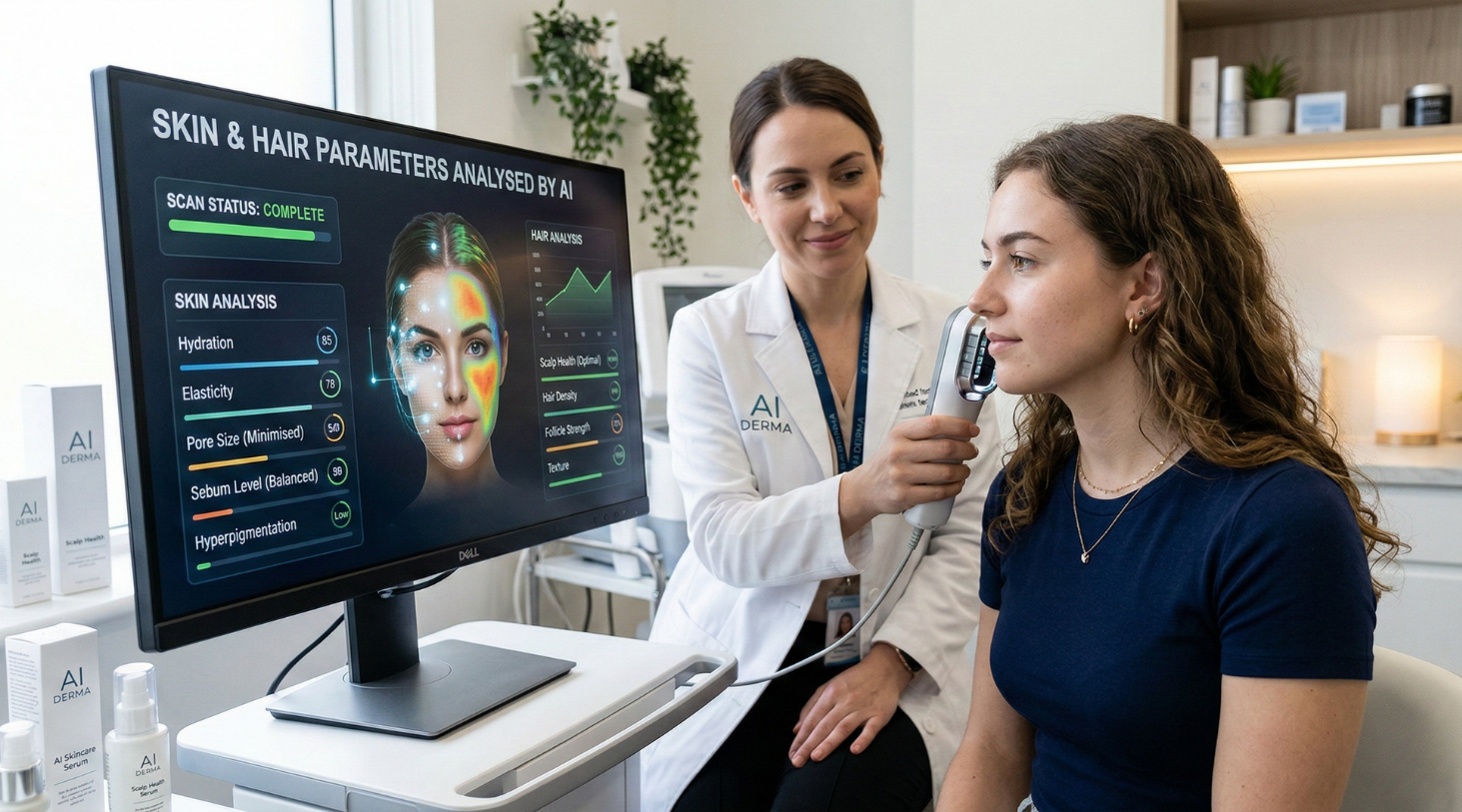
AI-based skin and hair analysis is one of the most technically distinctive areas in AI-driven beauty and wellness mobile app development. Unlike generic personalisation features, this functionality relies on direct input from mobile devices, primarily cameras and sensors, combined with machine learning models that interpret visual data.
In beauty and wellness mobile apps, AI analysis transforms a smartphone into a diagnostic tool, enabling users to receive personalised insights without visiting a clinic or salon.
How Mobile-Based AI Analysis Works
In custom mobile app development for beauty and wellness, skin and hair analysis typically follows a multi-step pipeline:
-
Image capture via mobile device:
Users capture photos or short videos under guided conditions (lighting, distance, angles). -
Pre-processing on device or backend:
Images are normalised for lighting, colour balance, and noise to reduce device variability. -
AI inference using trained models:
Computer vision models analyse features such as texture, tone, dryness, redness, hair density, or damage patterns. -
Result interpretation and UX presentation:
Raw AI outputs are translated into user-friendly insights, scores, or recommendations.
This pipeline is a common pattern in beauty and wellness app development, but the quality of results depends heavily on custom implementation rather than generic SDKs.
Skin & Hair Parameters Analysed by AI
AI models used in AI-powered beauty and wellness mobile apps can evaluate a wide range of parameters, including:
-
skin hydration and oil balance;
-
pigmentation and uneven tone;
-
fine lines or texture irregularities;
-
hair density and scalp visibility;
-
breakage, dryness, and surface damage.
These insights become the foundation for personalised routines, product recommendations, or progress tracking.
Example: AI Hair Analysis in a Custom Mobile App
In a custom mobile app development in a beauty and wellness project focused on haircare, AI analysis might be used as follows:
-
users capture a short video of their hair under natural light;
-
the app analyses hair shaft condition, shine, and breakage indicators;
-
AI classifies hair damage level and scalp condition;
-
results are mapped to tailored routines and product suggestions.
From a development perspective, this requires tight integration between the mobile client, AI inference services, and recommendation logic, something typically delivered through custom SaaS development services rather than off-the-shelf solutions.
Technical Considerations in Mobile AI Analysis
Implementing AI-based diagnostics in beauty and wellness mobile app development introduces several technical challenges:
-
handling inconsistent lighting and camera quality;
-
ensuring fast inference without excessive battery usage;
-
managing privacy for biometric and visual data;
-
updating AI models without breaking the mobile app.
These constraints often push teams toward custom architectures where AI services can evolve independently from the mobile client.
AI-Based Skin & Hair Analysis: Estimated Development Cost
|
Feature |
AI Capability |
Typical Use Case |
Estimated Development Cost |
|
Skin condition analysis |
Texture, tone, hydration detection |
Skincare mobile apps |
$8,000 - $15,000 |
|
Hair damage assessment |
Breakage, dryness, shine analysis |
Haircare & repair apps |
$10,000 - $18,000 |
|
Scalp analysis |
Density, irritation, sensitivity detection |
Hair & scalp wellness |
$15,000 - $25,000 |
|
Progress comparison |
Before/after visual tracking |
Long-term routines |
$6,000 - $12,000 |
|
AI-based diagnostics scoring |
Multi-factor skin/hair scoring |
Premium features |
$18,000 - $30,000+ |
Costs depend on dataset availability, model accuracy requirements, on-device vs backend inference, and privacy constraints.
Why Custom Development Is Critical Here
AI-based skin and hair analysis cannot rely solely on generic models or plug-and-play SDKs. Different brands require different thresholds, interpretation logic, and UX framing.
That’s why companies working with a SaaS development agency or investing in custom SaaS development services often treat AI diagnostics as a core platform capability. It ensures accuracy, adaptability, and alignment with brand expertise.
In practice, AI-powered analysis turns beauty and wellness mobile apps into intelligent assessment tools, bridging the gap between professional consultation and everyday self-care — directly through the user’s mobile device.
Smart Recommendation Engines in Custom Mobile App Development for Beauty & Wellness
In custom mobile app development for beauty & wellness, smart recommendations are implemented as a dedicated system layer rather than simple UI logic. Technically, recommendation engines sit between user behaviour tracking, AI diagnostics, and product or routine delivery, acting as a real-time decision layer.
Recommendation Engine Architecture
In beauty and wellness mobile app development, smart recommendations are usually powered by a hybrid architecture that combines rule-based logic with machine learning models.
A typical setup includes:
-
event tracking layer (user actions, routine completion, skips);
-
feature store aggregating behavioural and diagnostic signals;
-
decision engine combining rules and ML predictions;
-
delivery layer is responsible for surfacing recommendations in the app.
This separation allows recommendation logic to evolve independently from the mobile UI: a key advantage of custom mobile app development over template-based solutions.
Data Inputs and Feature Engineering
Smart recommendations in AI-powered beauty and wellness mobile apps rely on carefully engineered input features rather than raw data alone.
Common feature categories include:
-
diagnostic outputs (skin or hair condition scores);
-
behavioural metrics (frequency, consistency, fatigue signals);
-
temporal data (time since last action, seasonality);
-
contextual factors (routine stage, product usage history).
These features are continuously updated and fed into the recommendation engine to generate context-aware suggestions.
Combining Rules and Machine Learning
Purely ML-driven recommendations can be unpredictable, especially in wellness-related products. For this reason, beauty and wellness app development often combines AI models with expert-defined rules.
Typical patterns include:
-
rules defining safe boundaries and contraindications;
-
ML models optimising within those boundaries;
-
fallback logic when confidence scores are low.
This approach ensures recommendations remain aligned with brand expertise and regulatory expectations while still benefiting from AI-driven adaptation.
Real-Time vs Batch Recommendations
In custom mobile app development for beauty & wellness, teams must decide whether recommendations are generated in real time or through batch processing.
-
Real-time recommendations:
Used for in-session guidance and immediate adjustments. -
Batch recommendations:
Used for daily routines, notifications, and long-term planning.
Choosing the right balance impacts system load, responsiveness, and infrastructure cost.
SaaS-Oriented Recommendation Services
In many beauty and wellness mobile apps, recommendation engines are implemented as shared backend services rather than app-specific modules. This aligns with custom SaaS development services, where the same logic supports:
-
mobile apps;
-
admin dashboards;
-
analytics and experimentation tools.
This architecture enables controlled experimentation, A/B testing, and continuous improvement without redeploying the mobile client.
Performance, Explainability, and Monitoring
From an engineering standpoint, smart recommendation systems must be observable and explainable.
Key considerations include:
-
latency and response time;
-
confidence scoring and thresholds;
-
logging recommendation decisions;
-
monitoring outcome effectiveness.
In AI-driven beauty and wellness mobile apps, this transparency is essential for debugging, compliance, and long-term trust.
Why AI use cases differ across beauty and wellness markets
AI can bring real value to beauty and wellness apps, but that value does not look exactly the same in every market. The same product may need to solve different business tasks depending on where it is launched and what users expect from the experience. For a brand growing in the United States, AI may be most useful when it strengthens personalized product discovery, virtual consultations, and conversion-focused journeys that help users move быстрее from interest to purchase or booking. In the United Kingdom, the stronger opportunity may lie in improving repeat engagement through smarter rebooking flows, loyalty logic, and more consistent communication across the customer lifecycle.
The priorities can shift again in continental Europe. In Germany, AI may create more value when it supports structured service flows, clearer appointment logic, and better use of customer data in everyday operations. In Switzerland, the same technology often makes more sense as part of a premium, high-trust user experience, where recommendations, consultations, and wellness journeys need to feel personal, polished, and reliable. In Belgium, AI can play a particularly practical role by helping businesses keep service delivery more consistent across locations, improving follow-up recommendations, and making the customer journey easier to manage over time.
This is exactly why AI in beauty and wellness should not be treated as a standalone feature layer. Its role depends on whether the business is trying to drive conversion, increase retention, improve service quality, or make operations more predictable. In practice, that can translate into AI-powered recommendations, virtual consultation flows, intelligent booking logic, CRM-connected client profiles, loyalty features, or personalized wellness plans built around repeat engagement rather than one-time interaction.
For companies entering or growing in these markets, the real goal is not simply to add AI to the app, but to build the product around the way customers actually choose services, book appointments, return, and stay engaged. This is where custom mobile app development becomes especially valuable. JoinToIT can support that process through mobile app development, cross-platform engineering, UI/UX design, QA testing, DevOps, and dedicated team support for beauty and wellness businesses that need a product shaped around real market needs rather than a generic app template.
Trust, Privacy, and Responsible AI in Beauty & Wellness Apps
1.png "Beauty and wellness app is open on the laptop")
In beauty and wellness mobile app development, trust is not created by design alone; it is enforced through technical decisions. When AI systems process biometric data, images, and behavioural signals, privacy and responsibility must be embedded directly into the system architecture, not added later as policy statements.
Data Sensitivity in AI-Driven Beauty & Wellness Apps
In AI-powered beauty and wellness mobile apps, data inputs often include:
-
facial images and scalp photos;
-
skin and hair condition indicators;
-
routine adherence and behavioural patterns;
-
wellness-related self-reported data.
From an engineering standpoint, this data is inherently sensitive. Treating it like generic analytics data introduces significant risk.
For this reason, custom mobile app development for beauty & wellness typically applies stricter data classification and handling rules than standard consumer apps.
Privacy-First Data Architecture
A privacy-first approach in beauty and wellness app development starts at the data layer.
Common architectural patterns include:
-
separating personally identifiable data from AI feature data;
-
storing raw images only when strictly necessary;
-
using short-lived storage for biometric inputs;
-
applying encryption at rest and in transit.
In many projects, AI models operate on derived features rather than raw inputs, reducing exposure while preserving functionality.
On-Device vs Backend AI Processing
One of the key technical decisions in AI-driven beauty and wellness mobile app development is where AI inference takes place.
-
On-device processing:
Improves privacy by keeping sensitive data on the user’s device, but limits model complexity and update frequency. -
Backend processing:
Enables more advanced models and continuous improvement, but requires stricter access control, auditing, and data governance.
Custom architectures often combine both approaches, using on-device preprocessing with backend inference to balance privacy and performance.
Explainability and Model Boundaries
In AI-powered beauty and wellness mobile apps, explainability is a technical requirement, not just a UX choice.
Engineering teams typically implement:
-
confidence thresholds for AI outputs;
-
fallback logic to expert-defined rules;
-
explicit boundaries where AI suggestions are suppressed.
This prevents AI systems from producing misleading or overly confident outputs, especially in wellness-related scenarios.
Responsible AI Controls and Monitoring
Responsible AI in custom mobile app development for beauty & wellness is enforced through monitoring and control mechanisms.
Typical implementations include:
-
logging AI decisions and inputs for auditability;
-
tracking model drift and output stability;
-
versioning AI models independently from the mobile app;
-
disabling or rolling back models without redeploying clients.
These controls allow teams to respond quickly when AI behaviour changes unexpectedly.
SaaS-Level Governance for AI Systems
In many beauty and wellness mobile apps, AI logic is delivered through shared backend services. This aligns naturally with custom SaaS development services, where governance, access control, and compliance can be managed centrally.
This approach enables:
-
consistent privacy rules across platforms;
-
controlled experimentation and rollout;
-
clear ownership of AI decision logic.
From a technical standpoint, responsible AI becomes part of the platform’s infrastructure rather than a feature-level concern.
Architecture and Cost of AI in Beauty & Wellness Mobile App Development
AI features in beauty & wellness mobile app development are only as effective as the architecture that supports them. From diagnostics and recommendations to privacy controls and monitoring, AI introduces a system-level complexity that directly impacts development cost, scalability, and long-term maintainability.
This section breaks down how AI is typically structured in custom mobile app development for beauty & wellness, and how architectural choices translate into real budgets.
Typical AI Architecture for Beauty & Wellness Mobile Apps
In AI-driven beauty and wellness mobile app development, AI is rarely embedded directly into the mobile client. Instead, it is implemented as a layered system:
-
Mobile app layer:
Image capture, guided input, UX logic, and result presentation. -
AI service layer:
Computer vision models, recommendation engines, and inference APIs. -
Data layer:
Feature storage, anonymised datasets, logs, and analytics. -
Control & governance layer:
Monitoring, model versioning, access control, and rollback mechanisms.
This separation allows AI systems to evolve independently from the mobile app, which is essential in custom mobile app development projects that plan long-term growth.
MVP vs Scalable AI Architecture
Not every beauty or wellness product needs a full AI stack at launch. In practice, teams usually choose between two architectural approaches:
-
AI-light MVP:
Limited diagnostics, basic recommendations, and manual thresholds. -
Scalable AI platform:
Modular AI services, retraining pipelines, and advanced monitoring.
Choosing the right approach early helps control costs while keeping the product extensible.
Table: AI Architecture Components and Development Cost
|
Architecture Component |
What It Includes |
Typical Use Case |
Estimated Cost |
|
Mobile AI integration |
Camera flows, UX, and result display |
MVP & full apps |
$6,000 - $12,000 |
|
AI inference services |
CV models, recommendation logic |
Core AI features |
$12,000 - $25,000 |
|
Feature & data storage |
Behavioural + diagnostic features |
Personalisation |
$5,000 - $10,000 |
|
Model monitoring & control |
Logging, versioning, and rollback |
Production AI |
$6,000 - $15,000 |
|
Privacy & compliance layer |
Encryption, access control |
Regulated markets |
$4,000 - $8,000 |
|
Scalable SaaS backend |
APIs, dashboards, integrations |
Platform products |
$15,000 - $30,000+ |
Costs vary depending on model complexity, on-device vs backend inference, data volume, and compliance requirements.
Why Architecture Decisions Drive Cost More Than Features
In beauty and wellness app development, the biggest cost driver is not the number of AI features, but how they are architected. Poor architectural decisions often lead to:
-
expensive rework when models need updates;
-
limited experimentation capability;
-
security and compliance risks.
By contrast, well-structured AI systems allow teams to:
-
iterate on models without redeploying apps;
-
control infrastructure costs;
-
introduce new AI features incrementally.
This is why many companies choose to work with a SaaS development agency or invest in custom SaaS development services when building AI-driven beauty and wellness platforms.
Aligning Cost With Product Strategy
From a product standpoint, AI should be aligned with clear business goals:
-
diagnostics for differentiation;
-
recommendations for retention;
-
automation for scalability.
In custom mobile app development for beauty & wellness, this alignment ensures that AI investment supports growth rather than becoming technical debt.
Final Takeaway
AI is no longer an experimental add-on in beauty and wellness products; it is becoming a core capability that shapes user experience, scalability, and long-term product value. However, real impact comes not from isolated AI features, but from how intelligence is embedded into architecture, data flows, and product strategy from the start.
At JoinToIT, we work with AI as part of custom mobile and SaaS product development, helping beauty and wellness companies design, build, and scale AI-driven platforms responsibly. From early-stage MVPs to mature products, our focus is on aligning AI capabilities with real business goals, turning technology into a sustainable competitive advantage rather than technical complexity.
If your clinic needs more than an app, see our aesthetic clinic software work and how we approach custom mobile app development for client-facing booking.