
Introduction: Why AI Chatbots Are Essential in 2025
Through 2025, AI chatbots are a basic building block in SaaS systems. Driven by advancements in large language models (LLMs) and real-time data processing, modern chatbots are intelligent agents that can handle dynamic user input, interact with APIs, and execute backend processes autonomously.
In SaaS software, AI chatbots are no longer bound by pre-specified rule systems or fixed responses. Instead, they employ transformers, embeddings, and retrieval-augmented generation (RAG) to produce context-aware, multi-turn conversations. This enables real-time decision-making, dynamic customer flows, and personalised user engagement at scale.
From a SaaS development services perspective, chatbots reduce human dependency in support activities, provide digital product assistance, and enable AI-powered onboarding, feedback collection, and knowledge management.
Most SaaS development companies today incorporate chatbot architecture from the initial stages of SaaS MVP development, as an integral part of user experience design, and not as an afterthought post-launch.
In a modern application development stack for a SaaS, chatbots can be implemented directly within the UI (via React/Next.js), attached to backend microservices over WebSockets or RESTful APIs, and integrated with vector databases to pull semantically tagged content out of internal knowledge bases.
With LLM APIs like OpenAI’s Assistants, Google's Gemini, and open-source alternatives such as LLaMA or Mistral, chatbot deployment is faster, cheaper, and more secure, making them a default feature in today’s custom SaaS development services.
Simply put, AI chatbots in 2025 are no longer optional — they’re becoming the interface layer between users and data, shaping how people interact with software.
Top Tools and Platforms for AI Chatbot Development in 2025
The AI tooling ecosystem has come a long way by 2025, providing a prolific ecosystem for developers, architects, and Saas development companies to develop, deploy, and scale AI-powered chatbots quickly. The choice of tools highly depends on considerations such as model control, latency sensitivity, deployment approach (cloud vs. on-prem), and integration level in your SaaS architecture.
Below is a rundown of the earliest and most popular platforms and technologies embraced by modern Saas development agencies when rolling out chatbot systems:
OpenAI Assistants API (GPT-4o)
-
A high-level abstraction of GPT models that support multi-turn dialogue persistently, memory, function calls, and file operations.
-
Suited for SaaS products requiring advanced NLP without the hosting of model infrastructure.
-
Can accommodate embedded logic such as tool usage, RAG pipelines, and dynamic prompt injection.
Fits for: SaaS product development services that need integration faster with minimal backend overhead.
Google Gemini via Vertex AI
-
Provides scalable and secure LLM capabilities integrated into the Google Cloud Platform.
-
Smooth support for toolchains like Firebase, Dialogflow, and BigQuery.
-
Multimodal functionality (text, code, image) for stronger chat interfaces.
Fits for: Enterprises working with Saas software development services already integrated in the Google ecosystem.
Meta LLaMA + Mistral (Open Source)
-
Hosted locally or private cloud with Hugging Face, Ollama, or custom Docker images.
-
Grants full control, offline inference, and fine-tuning customizability.
-
Augmented with vector databases for on-premises RAG implementations.
Ideal for: Privacy-concerned proprietary SaaS development services or regulated industries (healthcare, fintech, legal tech).
LangChain + LangGraph + Vector DBs (e.g. Pinecone, Weaviate, Qdrant)
-
Provides a modular framework for building autonomous agents, pipelines, and memory-aware chatbots.
-
LangGraph (released in 2025) facilitates visual error handling and state management in agent flows.
-
Easily integrates with OpenAI, Cohere, Claude, and open-source models.
Ideal for: SaaS development services companies' technical teams building deep integrations or document-heavy AI chatbots.
Botpress, Rasa, Voiceflow
-
Drag-and-drop, open-source, and hybrid products for teams looking for full control of the UX and backend of a chatbot.
-
Embedded NLU, multi-language capabilities, and custom intent support.
-
Perfect for internal as well as customer-facing SaaS bots.
Recommended for: Product-led SaaS app development services with an emphasis on branded UX and latency-low interactions.
Bonus:
-
Gradio + FastAPI: Great for developing internal LLM tools to prototype.
-
Next.js + Clerk/Auth0: For frontend integration into authenticated SaaS environments.
-
Supabase + pgvector: Postgres alternative for Pinecone for RAG-based chatbots.
Choosing the Right Tech Stack: API, Hosting, and Frontend
Building production-readiness for an AI chatbot in 2025 involves more than just adding a new LLM API. To be scalable, secure, and responsive in real time, a modern chatbot solution must be designed as part of a larger SaaS app development offering. What follows is a breakdown of the key components — and how SaaS development services companies assemble their tech stacks.
API Layer (LLM, Backend Logic, Function Calling)
At the center of the AI chatbot is the API layer that controls all communication among the frontend, the LLM, and utilities from third parties:
LLM APIs:
-
OpenAI GPT-4o, Anthropic Claude 3, Google Gemini 1.5 Pro
-
Seek out usage limits, token fees, latency, and support for fine-tuning.
-
Most SaaS development companies develop a proxy middleware layer to regulate retries, model switching, and usage tracking.
Function Calling (Tool Use):
-
Allow the chatbot to trigger dynamic actions — like retrieving a user profile, generating a report, or scheduling a meeting.
-
Standard approach: OpenAI or LangChain Agent-based function definitions as JSON schema.
Backend Stack:
-
Languages: Node.js (Express/NestJS), Python (FastAPI), Go
-
Purpose: handle session logic, API auth, user management, message history, and async task queues (e.g., for long-processing agents)
Tip: SaaS product development agencies will often encapsulate chatbot logic in a microservice or serverless function to keep the core app lightweight and decoupled.
Hosting & Infrastructure
Depending on the complexity of the chatbot and its usage pattern, hosting can range from a lightweight serverless approach to full-blown container orchestration.
Serverless (Vercel, Cloudflare Workers, AWS Lambda):
-
Ideal for MVPs or low-traffic bots
-
Immediate deployment, edge performance everywhere
Containers (Docker + Kubernetes):
-
Used by enterprise-level SaaS applications with sensitive information or specialised LLM deployment needs (e.g., LLaMA, Mistral)
-
Supports enhanced autoscaling and performance management along with data traffic
Storage + RAG Infrastructure:
-
Use vector databases like Pinecone, Weaviate, or pgvector (PostgreSQL plugin)
-
Manage embeddings and semantic search over private data sources
Authentication + Multitenancy:
-
Tools: Clerk.dev, Auth0, Firebase Auth
-
Essential for multi-user SaaS applications with chatbot assistants that are associated with per-user data
Frontend & UI/UX Integration
Adding chatbots to your SaaS platform must be native and intuitive to the end user. Frontend stack matters for UX and performance.
React (Next.js):
-
Default for most web-based SaaS platforms
-
Can be injected as a floating widget, inline aide, or standalone dashboard
Tailwind CSS / shadcn/ui:
-
Shared design systems for styling chat interfaces responsiveness and accessibility-focused
Streaming Support:
-
Support token-by-token streaming responses for real-time feedback (over SSE or WebSockets)
-
Improved perceived performance and user interaction
Mobile Integration:
-
Flutter, React Native, or Swift + Kotlin for a SaaS application with integrated native chatbot support
-
Message-based composition of UX: swiping, voice input, and built-in suggestions
Most SaaS application development services companies have a single component library for chatbot UI together with the core SaaS UI to ensure brand consistency.
Next, we’ll cover the development timeline — from MVP chatbot to enterprise-scale deployment — and how SaaS development companies approach staging, testing, and iteration cycles.
Development Timeline: From MVP to Full-Scale Chatbot
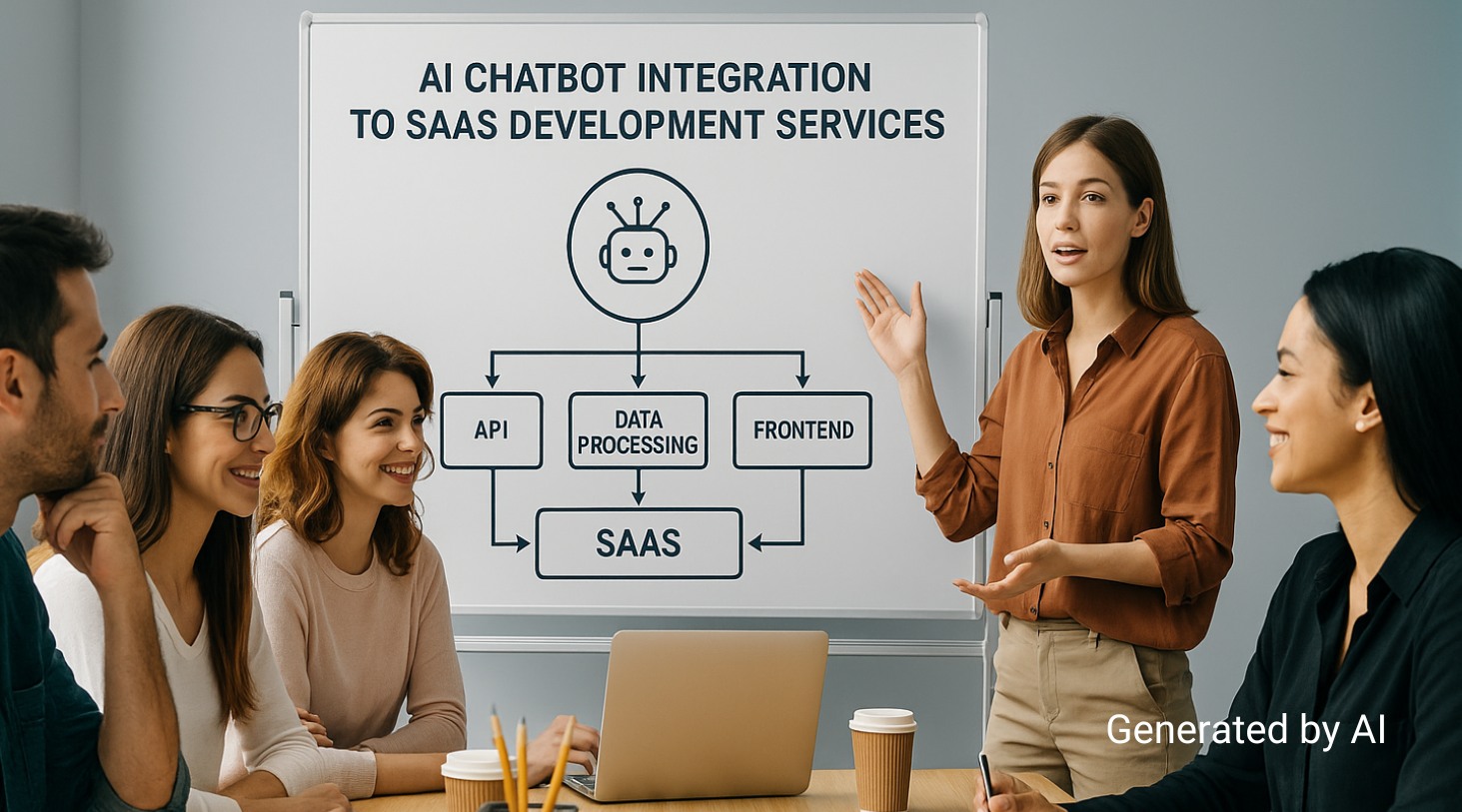
AI chatbot development in 2025 is iterative and modular. Whether it's a startup shipping your first SaaS MVP, or a product team in a big company adding AI to an existing app, the goal is to ship quickly, validate rapidly, and scale intelligently.
The following is a typical development schedule utilised by veteran SaaS development services companies:
Phase 1: Discovery & Scope Definition (Week 1)
-
Define business goals: support automation, lead gen, knowledge assistant, onboarding, etc.
-
Identify target users and UX expectations.
-
Choose LLM-as-a-Service (OpenAI, Gemini) or open-source deployment.
-
Output: use case design + data flow diagram.
This phase is pivotal to aligning the chatbot with your SaaS product development strategy.
Phase 2: MVP Build (Weeks 2–3)
-
Set up LLM API integration with fallback logic.
-
Create a backend for chat history, session context, and authentication.
-
Create a basic UI widget (React-based or embedded within the current SaaS app).
-
Simple RAG with CSVs, Notion pages, or FAQs as required.
For SaaS MVP development-driven clients, this is the fastest path to validating product-market fit.
Phase 3: Testing, Feedback, and Iteration (Week 4)
-
Internal QA (edge cases, fail states, LLM behaviour).
-
Collect user feedback for accuracy, UX, and latency.
-
Tune prompt strategies, system instructions, or embedding logic.
-
Add logging and analytics (e.g., OpenAI usage logs + custom event tracking).
Fine-tuning options or retraining tailored to this phase is an offering of most SaaS software development services firms.
Phase 4: Knowledge Base Integration + Memory (Week 5+)
-
Integrate with custom data sources (CMS, CRM, internal docs).
-
Vector database for semantic search (Pinecone, pgvector).
-
Implement context memory and persistent sessions for returning users.
This is where a bespoke SaaS development service comes in to add intelligence and personalisation to the chatbot.
Phase 5: Production Launch & Scaling (Week 6+)
-
Deploy chatbot onto production SaaS platform with user segmentation.
-
Monitor usage metrics (API cost, retention, error rate).
-
Add multi-language support, role-based flows, and analytics dashboards.
-
Schedule long-term support, rate-limiting, and cost optimisation.
Most SaaS development agencies recommend launching the bot as a feature flag or beta toggle to control rollout.
Summary Table:
|
Phase |
Timeline |
Deliverables |
|
Discovery & Scope |
Week 1 |
Use cases, architecture plan |
|
MVP Build |
Weeks 2–3 |
Chatbot backend + UI |
|
Testing & Iteration |
Week 4 |
Polished prototype |
|
Knowledge & Memory |
Week 5 |
Vector DB, personalised context |
|
Scaling & Launch |
Week 6+ |
Production deployment |
Next, we’ll break down costs — from MVP budgets to enterprise AI chatbot deployments — including API usage, dev hours, and long-term support models used by leading SaaS development companies.
Costing Breakdown in 2025
The cost of developing an AI chatbot in 2025 is very prohibitive based on use case complexity, choice of AI model, amount of integrations required, and whether you are building an MVP or scaling an enterprise-grade assistant. SaaS teams need to be aware of both the cost of initial development and the cost of running (mainly API usage and hosting).
Below is a listing of typical pricing levels used by modern SaaS development services companies.
1. MVP AI Chatbot
For SaaS MVPs and early-stage startups
Features:
-
Basic LLM API integration (OpenAI, Claude, Gemini)
-
FAQ-style conversations, fixed prompts
-
Chat UI widget + backend session logic
Timeline: 2–3 weeks
Estimated Cost: $5,000 – $10,000
Usually part of SaaS MVP development packages provided by agile SaaS development agencies.
2. Mid-Level SaaS Chatbot
For SaaS knowledge base + API integration
Features:
-
RAG setup with private docs or knowledge base
-
Authentication-aware conversations (user-specific data)
-
Advanced prompt chaining or tool calling
-
Logging, basic analytics, and error handling
Timeline: 4–6 weeks
Estimated Cost: $12,000 – $25,000
Recommended for SaaS teams who are ready to move up from MVP to scalable SaaS application development solutions.
3. Enterprise AI Chatbot
For B2B SaaS, enterprise-scale platforms, or internal enterprise applications
Features:
-
Custom LLM deployment (on-prem or private cloud)
-
LangGraph-style agent workflows, memory, and state control
-
Multi-language support, voice/chat hybrid interface
-
Admin dashboards, analytics, and billing integration
Timeline: 6–12+ weeks
Estimated Cost: $30,000 – $75,000
Usually offered by experienced Saas development companies with expertise in fintech, healthcare, or legaltech.
Ongoing / Hidden Costs to Consider
|
Cost Item |
Estimated Range |
Notes |
|
LLM API Usage |
$20–$500/month |
Depends on token volume & model used |
|
Vector Database (e.g. Pinecone) |
$50–$200/month |
Based on index size and usage |
|
Serverless Hosting |
$10–$100/month |
For frontend/backend API |
|
Monitoring & Logs |
$20–$150/month |
For observability, alerts |
|
DevOps & Maintenance |
Custom retainer |
Often added to SaaS software development services retainers |
By having a full-service SaaS development agency, you have access to reusable building blocks, templates, and pre-trained integration flows — which can reduce development time and cost by up to 40% compared to a custom from-the-ground-up implementation.
Pro tip: Always request an estimate for token consumption before going live with an LLM-based bot — costs can creep up quickly.
Conclusion: What's Next for AI Chatbots in SaaS
Chatbots enabled by AI are emerging as the glue that binds modern SaaS apps together — responding to queries, yes, but also triggering workflows, offering insights, and serving as fluid conduits between users and data.
By 2025, the SaaS development leaders will be integrating first-class AI chat assistants as part of product features, not third-party add-ins. With the evolution of large language models (LLMs), chatbots will move beyond typed queries — being a part of voice, screen share, and multimodal input (images, documents, diagrams) to enable more natural and richer communication.
New trends shaping the next generation of SaaS application development services include:
-
Multimodal Chat Interfaces
AI chatbots capable of interpreting screenshots, PDFs, or product mockups — not words alone. -
On-Prem LLM Deployment
Private model hosting (e.g., with LLaMA or Mistral) is becoming a requirement for security-minded SaaS platforms. -
LLM Agents with Memory + Planning
Bots with memory of previous conversations, setting user goals, and as an autonomous product copilot. -
Vertical SaaS Specialisation
Niche-specific chatbots (legal, medical, fintech) embedded in core processes, trained on special-purpose data.
For SaaS development teams, the path forward is clear: go fast and grow smart with the appropriate development partner. Whether you're planning a SaaS MVP prototype or expanding an established product, AI chatbots are now a core plank of product strategy — and the best results come from partnering with a SaaS development services organisation that understands both the technology and business context.
Do you need help building your AI chatbot?
JoinToIT offers custom SaaS development solutions, including AI-powered chatbot development, integration, and deployment — from MVP to complete platforms.
Let's smarten up your product — let's talk.