
What Is Bluetooth Inventory Tracking in SaaS Development and Why Retailers Need It Now
In modern times, retailers need to manage inventories across physical stores, warehouses, and dark stores, continuing into online channels. Spreadsheets, legacy on-prem systems, and physical stock counts cannot keep pace with real-time demand and omnichannel fulfilment.
Bluetooth Inventory Tracking changes that. Combined with an enterprise-class, well-designed cloud platform developed by a SaaS development company, it gives retailers live visibility from the stockroom right out to the point of sale across every store and every shelf.
Bluetooth Inventory Tracking: From Hardware to SaaS Platform
It involves the use of Bluetooth beacons, tags, or devices attached to products, boxes, or shelves for general-level item tracking. Those signals are then picked up by mobile apps or handheld scanners or fixed receivers and transferred to the cloud.
From a SaaS development viewpoint, this is a full-fledged digital product, not just a hardware setup:
-
A mobile app that lets store personnel receive, move, and count items in real time.
-
Cloud backend receiving Bluetooth events, processing and updating inventory status.
-
Web-based dashboard where managers can view stock levels, stock movements, and alerts across all locations.
-
API-based integrations with POS, ERP, WMS, and e-commerce systems.
This is where professional custom SaaS development services come designing a secure, scalable, multi-tenant platform to support multiple retailers, hundreds of stores, and thousands of devices.
Why Retailers Need Bluetooth Inventory Tracking Now
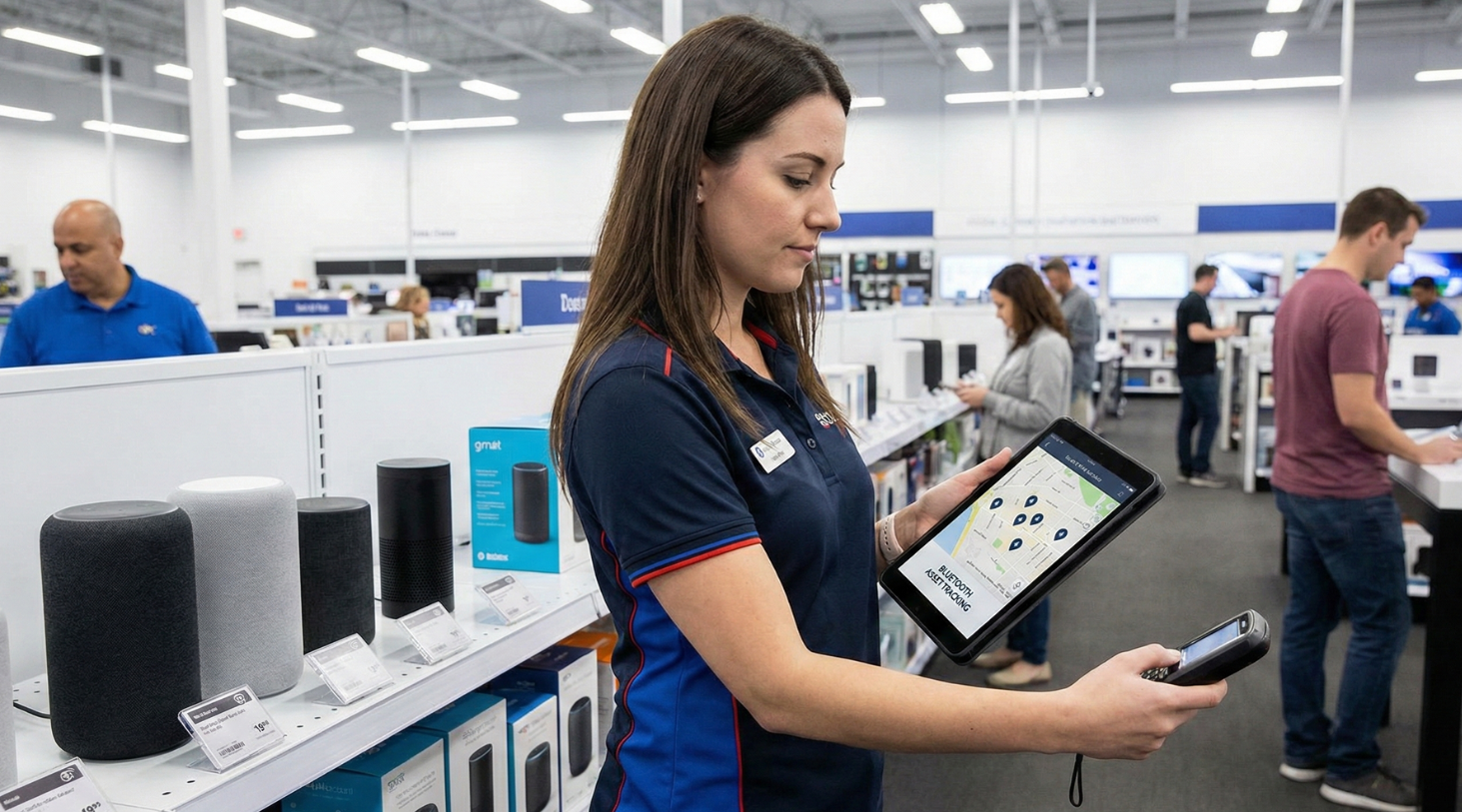
Without real-time inventory visibility, retailers continue to lose money and the trust of customers:
-
Products show "in stock" online, but are not present in the store.
-
Inventory accumulates in the stockroom, but the shelves seem empty.
-
Manual inventory counts consume staff time and are outdated the moment they’re finished.
-
Promotions and seasonal campaigns are planned with incomplete or inaccurate data.
A Bluetooth Inventory Tracking system, delivered as a SaaS product, helps solve:
-
Every movement of goods, from the stockroom to POS, is captured automatically.
-
Changes in inventory ripple throughout all connected systems in real time.
-
Managers will then use one unified SaaS dashboard to view accurate stock information, item locations, and discrepancies.
-
Decisions on replenishment, markdowns, and allocations are based on real data and not guesses.
That is why more and more retailers today reach out to a SaaS development agency to build and implement a cloud-native Bluetooth-enabled inventory tracking platform.
From MVP to Full-Cycle SaaS Development
When the SRS (Software Requirements Specification) is agreed upon, the project proceeds to perform full-cycle software development:
-
MVP SaaS to validate the Bluetooth Inventory Tracking concept in a limited number of stores.
-
Iterative improvements based on direct feedback from practical store staff and management.
-
Scale architecture, harden security, and optimise performance as devices and locations are added.
The following can be addressed by an experienced SaaS development partner:
-
backend and API design for the core Bluetooth Inventory Tracking engine;
-
mobile apps for store teams (iOS/Android) tailored to in-store workflows;
-
web dashboards for HQ and regional managers;
-
ongoing support, monitoring, and feature delivery to keep the platform stable and evolving as a SaaS product.
Otherwise said, Bluetooth Inventory Tracking is a strategic SaaS platform with the intent of giving retailers real-time visibility they can use to protect margins, improve customer experience, and scale.
From Shelf to Smartphone: How Bluetooth Inventory Tracking SaaS Development Actually Works
The concept of "Bluetooth Inventory Tracking" can sound abstract or overly technical when spoken in conversation with retailers. The reality is that a well-designed Bluetooth Inventory Tracking SaaS platform merely mirrors what has been in the store, receiving goods, moving boxes, and filling shelves, but making every step visible in real time on a smartphone or dashboard.
This section walks through how it actually works-from a SaaS development perspective-from product on the shelf to data in the cloud.
Step 1: Bluetooth tagging of products, shelves, and locations
It all starts in the stockroom, not in the app:
-
Products, pallets, or boxes are labelled with either Bluetooth beacons or Bluetooth-enabled labels.
-
Fixed beacons might also be placed in specific zones, such as the stockroom, aisle 3, promo stand, and click-and-collect area.
-
Each beacon has an individual ID that the system can map to: a product / SKU, a location (shelf, section, stockroom zone) or a container (box, pallet, rack).
Step 2: Movement Detection through Mobile Applications and Scanners
Store staff use a mobile app (iOS/Android) developed in the scope of SaaS application development services:
-
The app is constantly looking for Bluetooth signals nearby.
-
When a worker moves a box from the stockroom onto a shelf, for instance, the app identifies:
-
which beacon(s) are nearby;
-
which user acted;
-
which zone or location they are currently in.
Common flows implemented during SaaS MVP development:
1. Goods receipt:
-
Staff scan delivery, and the app matches beacons with expected SKUs.
-
Items are marked as “Received in stockroom”.
2. Replenishment from the stockroom to the shelf:
-
Staff walk with a cart; the app registers the move from “Backroom” to “Aisle X / Shelf Y.”
3. On-the-fly stock checks:
-
Staff open the app in front of a shelf; the app shows which products/beacons “should” be there vs. what is actually detected.
Step 3: Sending Events from Smartphone to Cloud
Every time something relevant happens, and the mobile app detects it, it sends this event to the cloud backend:
-
"Beacon A123 was moved from Location 'Stockroom' to ‘Front Display 1’".
-
"Beacon B456 no longer detected in Aisle 5".
Here's where full-cycle custom software development is crucial:
-
Events are securely sent to a back-end via APIs.
-
The backend validates, enriches and stores them.
-
Real-time processing layer updates the inventory status across systems.
This is when the platform stops being “just an app” and becomes a real SaaS product:
-
Multi-tenant design means one platform can serve many retailers.
-
Scalable event processing across thousands of devices and stores.
-
Proper monitoring, logging, and error handling are also part of the full-cycle development.
Step 4: Update Inventory and Expose Data to Other Systems
Once Bluetooth events are received on the cloud, internal stock states are updated by the Bluetooth Inventory Tracking logic:
-
Quantity in the stockroom;
-
Quantity on shelf;
-
Available to Promise for e-Commerce;
-
Click-and-collect or ship-from-store reserved items.
Through integrations put in place, the platform synchronises with:
-
POS systems to ensure sales reduce on-hand stock correctly.
-
ERP and WMS to keep corporate inventory and logistics in sync.
-
Web store/OMS - To prevent selling items that are no longer available.
Step 5: Surfacing Insights on Smartphones and Dashboards
Now we come back “from cloud to smartphone”.
The same Bluetooth Inventory Tracking SaaS platform ingests events and provides:
Mobile UI for store staff:
-
"What's in this aisle?"
-
“What am I restocking next?”
-
"What products are not on the promotional stand?"
Web-based dashboards for managers and HQ:
-
Real-time visibility from the stockroom to the POS across every location.
-
Heatmap representations of stockout, overstock, and shrink risks.
-
Alerts on any unusual movements or discrepancies.
This is where the expertise of SaaS product development services really matters: UX, performance, and role-based access are as important as the backend itself.
Companies usually rely on a SaaS development partner to:
-
Design intuitive dashboards and mobile flows.
-
Provide for secure authentication and permissions.
-
Ensure that the system works seamlessly-from low-end devices to spotty Wi-Fi.
Step 6: Iteration, Scaling and Continuous Improvement
Bluetooth Inventory Tracking is not a project but an evolving SaaS platform:
-
Start with a SaaS MVP in selected pilot stores.
-
Collect feedback from staff and managers.
-
Extend features, analytics, and automation.
By partnering with a company offering full-cycle SaaS application development services, retailers can add sophisticated analytics modules without breaking the core platform, expand from one country into many, from a dozen stores into hundreds of stores, and continuously improve processes, adapting to the altering market and expectations of customers.
This is what the full lifecycle looks like, developing Bluetooth beacons and a mobile app into a strategic, revenue-impacting Bluetooth Inventory Tracking SaaS solution.
From Stockroom to POS: Real-Time Visibility Across the Retail Floor
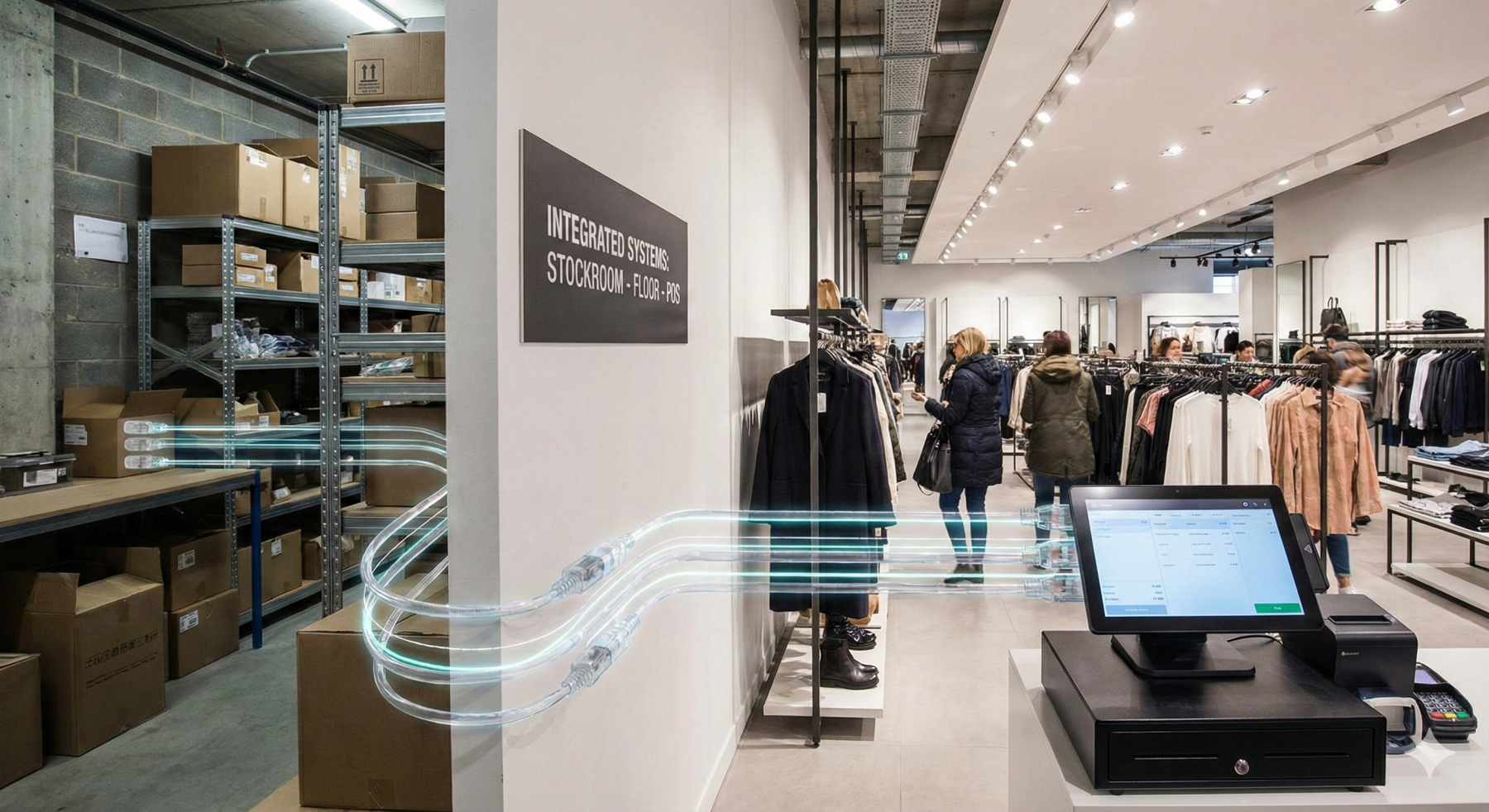
Bluetooth Inventory Tracking only pays dividends when everyone in the shop, from stockroom staff to store managers and HQ, has the same real-time truth on inventory. That's where a well-designed SaaS Tracking platform becomes a strategic asset, not just another IT system.
Single Source of Truth for Stockroom, Shelves and POS
In many retailers, each system has its own version of “reality:
-
According to POS, 5 units are left.
-
The ERP shows 8.
-
The product is already gone from the shelf.
-
There is still an unopened, full box in the stockroom.
A Bluetooth Inventory Tracking solution built as a SaaS application solves this by giving every role access to the same cloud-based data:
-
Store associates view real-time stock and item locations on their smartphones.
-
Store managers can view which areas are understocked or overstocked.
-
Regional managers and HQ see views aggregated across all stores.
This is only possible when SaaS platform developers design the system as a single, multi-tenant SaaS product and not as a patchwork of disconnected tools.
Real-Time Signals, Real-Time Decisions
The key value of Bluetooth Inventory Tracking is that the status of inventory changes instantly when the items start moving:
-
A box moves from the stockroom to a promo stand; the SaaS platform immediately updates the location and availability.
-
Items are sold at the POS: on-hand quantity is reduced and is reflected in all integrated systems.
-
Staff detect missing items on the shelf: the system flags discrepancies and potential shrinkage.
Role-based views across the retail floor
Real-time visibility doesn't mean that everybody sees the same UI. A good solution of SaaS application development provides every role with exactly what is needed:
Store associate mobile app
-
What's in this aisle right now?
-
“Which items do I need to restock from the stockroom?”
-
"Where is this particular SKU that the customer just requested?"
It gives immediate answers to these questions through the use of Bluetooth proximity data and cloud inventory, all built as part of full-cycle mobile application development services.
Store manager (tablet or web dashboard)
-
"Which shelves are understocked?"
-
“Where do we have blocked stock sitting in the back?
-
Which SKUs are most often out of stock at POS?
In general, such dashboards are developed by full-cycle web development, using the same backend.
Regional Manager / HQ (SaaS analytics)
-
"Which stores have shrinkage or accuracy issues?
-
"Where do we need to adjust planograms or replenishment frequency?"
-
"What locations are ideal pilots for new omnichannel services?"
Here, SaaS product development services come in: on top of the same Bluetooth-driven inventory data, design multi-level analytics and permission models.
Integrations Connecting Stockroom, Retail Floor, and Point of Sale
Real-time visibility across the retail floor is not confined to what staff see in the app. A good Bluetooth Inventory Tracking solution becomes the integration hub for inventory data:
-
POS systems verify items are really in stock by using the SaaS API so as to minimise failed sales.
-
ERP and WMS obtain clean, near real-time updates rather than delayed batch imports.
-
E-commerce and order management systems get accurate "available to promise" quantities per store.
In other words, this real-time visibility from the stockroom to POS is not a one-off project; it's ongoing, full-cycle software development where SaaS developers work together to continually refine how the business sees and uses its inventory data.
Key Components of a Bluetooth Inventory Tracking Architecture in SaaS Development (App, Beacons, Cloud, POS)
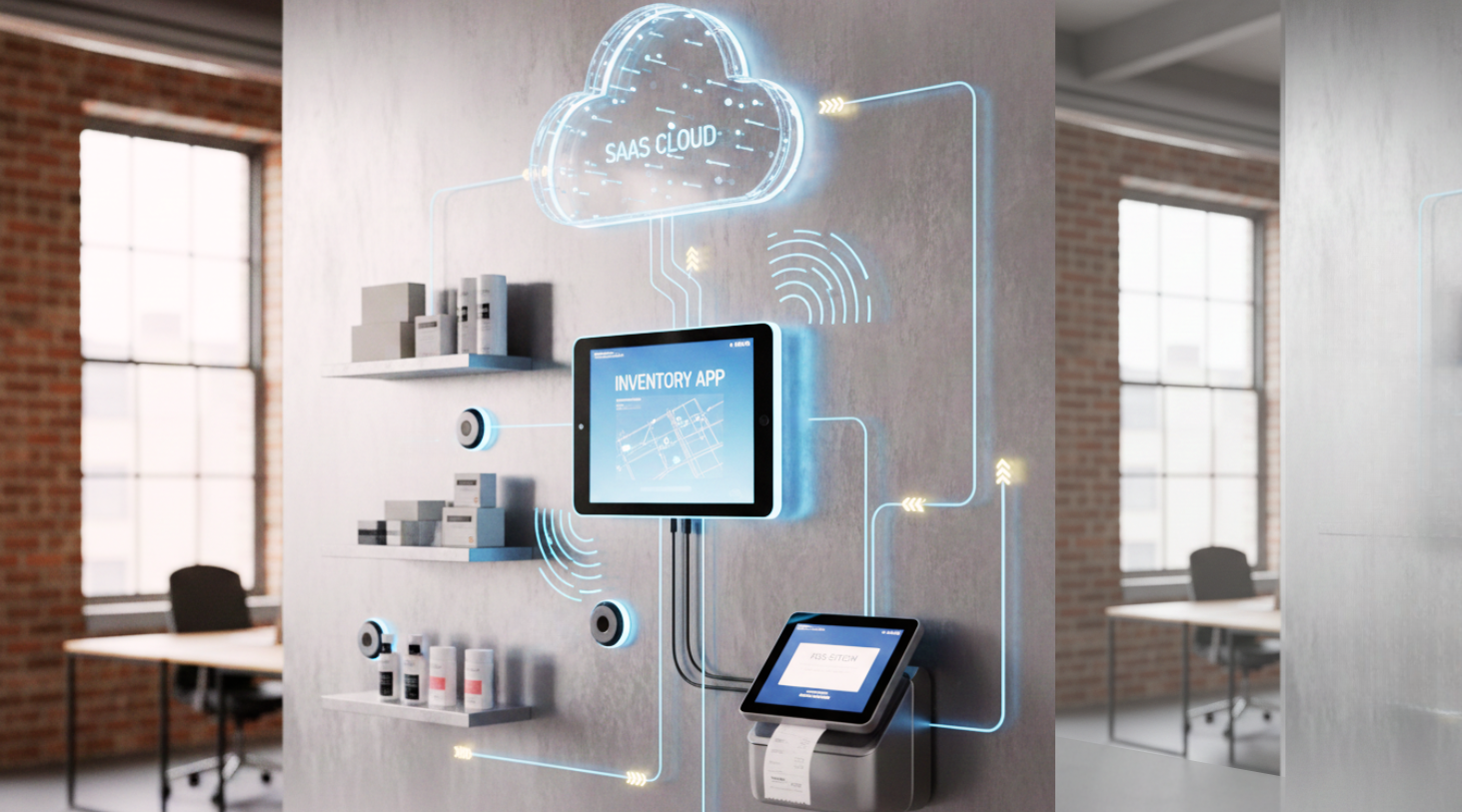
Behind every "scan-and-see" Bluetooth Inventory Tracking solution stands a clear, well-documented architecture. If you plan to build it as a scalable SaaS product rather than a one-off tool for a single retailer, you need more than an app and beacons; you need a consistent blueprint.
In practice, such a blueprint is formalised in an SRS (Software Requirements Specification) document and implemented by a SaaS development company. The core building blocks that normally compose this architecture are described below.
Mobile App: Lightweight Client for Store Operations
It is the mobile app where store employees interact with the system, but in SaaS, it should remain as lightweight as possible.
A well-designed application normally would:
-
Handles Bluetooth scanning and basic offline caching.
-
Guides the staff through receiving, moving, counting, and adjusting stock.
It displays real-time inventory and task lists pulled directly from the cloud.
Most of the heavy lifting-inventory rules, permissions, and analytics live in the backend. This "thin client" approach to development makes it easier to:
-
Roll out new logic without forcing app rewrites.
-
Support multiple platforms: iOS, Android, and dedicated handhelds.
-
Iterate rapidly on UX as the product evolves from SaaS MVP to full-featured platform.
It ensures that all critical flows and edge cases, along with API contracts, are captured upfront in the SRS within software engineering so that business and SaaS platform developers speak one language.
Bluetooth Beacons and Tags: Hardware-Aware, Vendor-Agnostic
The second building block consists of the Bluetooth layer itself: beacons, tags, and receivers that provide proximity and movement data.
From the perspective of custom SaaS development services, the main objective was to make the platform:
-
Vendor-agnostic: The backend works with a generic concept of BeaconId, SignalStrength, and Zone instead of hard-coding a single hardware provider.
-
Configurable: Mapping between beacon IDs, SKUs, and locations is configurable per retailer or per store.
-
Resilient against noise: The system copes well with overlapping signals, reflections, and “busy” RF environments typical for a retail floor.
These rules are defined in the SRS document, rather than in code comments. That allows your SaaS engineering team to:
-
Change hardware vendors without rewriting the core platform.
-
Support various tagging strategies: only high-value items vs. entire assortment tagging.
-
Roll out pilots in new regions with minimal engineering effort.
Cloud Backend: Multi-Tenant Inventory Engine
The cloud backend is at the heart of the Bluetooth Inventory Tracking SaaS. Bluetooth events, user actions, and the POS are merged into a single consistent view of inventory here.
A typical backend designed by a full-cycle software development company would include:
Event Ingestion Layer
-
Receives data from mobile apps, gateways, and external systems.
-
Normalises and validates events before processing.
Inventory engine
-
Applies the Business Rules defined in the SRS report: how a move, sale, or adjustment impacts stock in the stockroom, on the shelf, and at POS.
-
Keeps historical timelines current to support analytics and audits.
Multitenant SaaS architecture
-
Isolates data per retailer (tenant); also provides role-based access inside each tenant.
-
Supports different configurations, pricing plans, and feature sets in the same codebase.
Security, performance and reliability
-
Authentication and authorisation are in line with enterprise standards.
-
Horizontal scaling for peak periods of trading.
-
Latency, error, and integration failure monitoring and alerts.
That is where the full-cycle software development services become so critical: you are developing not just one project, but a platform that must be safe to scale.
Integration Layer: Clean Contracts with POS, ERP, WMS and E-Commerce
Bluetooth Inventory Tracking will only make sense for retailers if it sits in the middle of an existing ecosystem: POS, ERP, WMS, and online channels.
The integration layer normally includes:
Well-Defined APIs:
-
REST endpoints for inventory queries and updates.
-
Webhooks for pushing events to external systems (stock changes, discrepancies, alerts).
-
Versioning strategy: evolve the API without breaking clients.
Configurable synchronisation strategies:
-
Real-time push for critical events, such as stockouts at POS.
-
Less critical data: scheduled or batched sync
-
Mapping of Product IDs, Locations and Units of Measure per Retailer
Observability and Governance: Keeping the Platform Under Control
Finally, a production-grade Bluetooth Inventory Tracking SaaS has to be observable and governable from day one.
This means:
Observability by design
-
Metrics for event throughput, processing latency, and error rates.
-
Inventory change and user action audit logs.
-
Traces across mobile app - API - inventory engine - integrations.
SRS as a living document
-
Requirements are not frozen upon the MVP; they evolve along with the product.
-
Every feature addition, integration, or SLA modification revises the SRS document, which continues to keep the product, engineering, and retail stakeholders in sync.
Within such a framework, the software development partner is genuinely capable of providing full-cycle SaaS application development services from architecture to implementation, rollout, and further long-term evolution of the platform.
How Much Does a Bluetooth Inventory Tracking System Cost to Build?
There isn't a single price tag for the development of a Bluetooth Inventory Tracking solution. All depends on what exactly you want to build: a small pilot, an internal tool for one retail chain, or a full multi-tenant SaaS platform that you can then roll out and resell.
The most realistic notion about the budget would be per phase.
Phase 1: Discovery & SRS
The single cheapest line item in any serious Bluetooth Inventory Tracking project is usually the most important one: Discovery & SRS.
During the said stage, the SaaS development services company collaborates with your team in the following:
-
map real-life retail processes from stockroom to POS;
-
Establish basic workflows: receiving, movements, counts, discrepancies, alerts.
-
Identify all systems to be integrated, which are POS, ERP, WMS, and e-commerce.
-
Describe a native cloud, multi-tenanted SaaS architecture.
It produces an SRS document that is used for describing user roles, use cases, integration contracts, and non-functional requirements in a structured manner. To the product team, this is the single source of truth that drives implementation.
Phase 2. SaaS MVP: A Real System in Real Stores
Moreover, there is already SaaS MVP development for the first version of your Bluetooth Inventory Tracking system that actually runs in live stores.
A typical SaaS MVP can include :
-
A cross-platform mobile app for in-store staff with iOS and Android, featuring core workflows and Bluetooth scanning.
-
Cloud backend, providing a simple inventory engine along with event processing.
-
1–2 critical integrations-usually the main POS and an ERP or WMS.
-
Simple dashboards: stockroom vs. shelf vs. POS visibility.
This is where SaaS app development services come in: to turn the SRS into actual software.
Phase 3. From MVP to Full SaaS Product
A full-cycle software development company at this stage helps you develop the solution into a real Bluetooth Inventory Tracking SaaS:
-
Improve multi-tenancy for more retailers or business units.
-
More integrations of POS, ERP, WMS, and OMS.
-
Building advanced analytics, alerting, and reporting.
-
Bill, SLA, audit logs, SSO, and enterprise security are to be implemented.
Phase 4. Continuous Investment: Cloud, Support, and New Features
Finally, a Bluetooth Inventory Tracking solution built as SaaS is not a "launch and forget" project.
It requires ongoing investment in:
-
cloud infrastructure and observability;
-
new features, performance improvements and UX tweaks;
-
evolving integrations as external systems change;
-
security updates and compliance work.
You can cover it with your in-house team, or in partnership with a SaaS engineering team providing full-cycle software development services on a long-term basis.
Example project
- Mid-sized fashion retailer with 40 stores.
- Want real-time visibility from the stockroom to the POS.
- Will start with a pilot in 5 stores & then propagate throughout the chain.
- The long-term goal is to have the platform as a SaaS product that they control completely and can resell at a later date.
|
Phase |
Scope (Example) |
Main Deliverables |
Indicative Cost Range |
|
1. Discovery & SRS (6-8 weeks) |
40-store fashion retailer, pilot in 5 stores, POS + ERP integration |
Workshops, process mapping, SRS document, architecture, UX wireframes, integration specs |
$15,000 - $25,000 |
|
2. SaaS MVP (3-5 months) |
Pilot rollout to 5 stores |
Mobile app (iOS/Android), cloud backend, Bluetooth handling, basic inventory engine, dashboards, POS + ERP integrations |
$70,000 - $120,000 |
|
3. Scale-Up to Full SaaS Product (6-12 months, iterative) |
Rollout to all 40 stores + “productizing” the platform |
Multi-tenant hardening, more integrations, analytics, RBAC, billing, SLAs, performance & security improvements |
$100,000 - $250,000+ over time |
|
4. Ongoing Operations & Evolution (monthly) |
Keeping the platform running and evolving |
Cloud hosting, monitoring, support, feature roadmap, new integrations, optimisations |
$5,000 - $25,000 / month depending on team size and ambition |
Business Impact: How Bluetooth Inventory Tracking Improves Margins, CX and Scaling
Once Bluetooth Inventory Tracking is deployed as a SaaS platform, it is no longer a "nice-to-have" technology project; instead, it acts like a business lever. It impacts three things that matter to every retailer: margins, customer experience, and the ability to scale operations without losing control.
Margin Improvement: Making Inventory Work for You, Not Against You
The first area in which impact becomes visible is profitability.
Less shrinkage and fewer surprises
Bluetooth-based tracking of inventory while recording each movement from delivery to stockroom, from stockroom to shelf, and from shelf to the point of sale makes it far easier to:
-
see where items go missing or get miscounted;
-
Identify trends and patterns of shrinkage and process breakdown.
-
react before issues turn into repeated, costly losses.
Reduced safety stock and better use of capital
Predictably, when the inventory data cannot be trusted, retailers overcompensate with extra stock "just in case". That ties up working capital and often results in markdowns.
What a Bluetooth Inventory Tracking SaaS offers:
-
A more accurate picture of what is actually available in each store and zone
-
The confidence to reduce buffer stock where it is not needed.
-
earlier detection of slow movers and dead stock.
This, over time, means better sell-through and fewer margin-eating discounts.
More predictable promotions and markdowns
Promotions, seasonal campaigns, and markdown strategies all depend on knowing what you really have on hand.
With real-time inventory:
-
Marketing and merchandising teams get to see the true starting point of each store.
-
They can track the velocity with which the stock is moving while the campaign is on.
-
They may make changes in their allocations or discounts before the problem is evident to the customer.
Instead of reacting to the stock issues when this promotion has failed, the business can steer while it is still running.
Customer Experience: Keeping Promises About Availability
To the customer, the inventory system is not visible. What they feel is simple: the product is either there when they expect it, or it isn't.
Fewer "empty shelf" moments
Real-time visibility into the stockroom vs. the shelf means:
-
The staff is able to restock at the necessary times.
-
Managers can see what categories regularly go empty on the floor.
-
"phantom stock" (items the system shows but the store can't find) is detected and corrected faster.
What this means in practice is more completed visits where the customer actually finds what they came for.
More reliable omnichannel services
Click-and-collect, reserve online / pick up in store, and ship-from-store are only as good as the inventory data behind them.
Once Bluetooth Inventory Tracking SaaS is integrated with e-commerce and order management:
-
Online availability reflects what is really in each store.
-
personnel do not spend time searching for items that exist only "on paper";
-
Cancellations and broken promises are minimised ("Sorry, we actually don't have it").
This directly helps in attaining higher customer satisfaction and trust in the brand.
Stronger role of store staff
Simple mobile interface. Backed by accurate data that changes how the store teams work: instead of guessing or "checking it in the back" for several minutes, they can:
-
Quickly confirm availability and exact location.
-
Recommend looking for alternatives or other stores if a product is unavailable.
-
Focus more on service, less on hunting for products.
That combination of speed and confidence is noticeable from the customer side and improves perceived quality of service.
Scaling: From Pilot to Network Without Losing Control
The third dimension of impact is scalability. A Bluetooth Inventory Tracking solution that's built as a multi-tenant SaaS platform behaves very differently from a one-off, store-specific system.
Faster ramp-up, less incremental cost
Because it is cloud-native, configuration-driven :
-
Basically, adding a new store works mainly on location, user, and hardware configuration.
-
The very same basic logics and integrations are being applied again and again within the network.
-
Updates are deployed centrally, rather than being repeated store by store or regionally.
This enables retailers to go from a small pilot to dozens or hundreds of stores, without multiplying IT complexity at the same pace.
Standardised processes with the possibility of local particularities
Another one of the biggest advantages of a SaaS approach is standardisation.
-
Inventory Workflows: Receive, Move, Count, Adjust
-
exception handling - discrepancies, shrink flags, alerts;
-
Reporting and KPIs across the organisation.
At the same time, configuration options allow local deviations-different product ranges, layouts, or integration settings-avoiding forking of the codebase.
Building a long-term data asset
All movements, adjustments, discrepancies, and sales recorded through the Bluetooth Inventory Tracking SaaS create a continually growing dataset.
This, in turn, over time enables:
-
more accurate forecasting and replenishment.
-
better planning of promotions and staffing;
-
Experimentation with automation and AI-driven optimisation.
Said otherwise, the system doesn't just solve today's visibility problems; it builds the data foundation for the improvements of tomorrow.
From Technology Project to Strategic Platform
All this impacts better margins, stronger customer experiences, and easier scaling, depending on the design and build of the solution. A one-off, store-specific project will showcase what Bluetooth Inventory Tracking is capable of.
Designed with great professionalism and implemented by an experienced engineering partner, such a system can:
- evolve with your business model;
- support multiple business units or even external customers;
- and be maintainable, observable, and secure long term.
Used this way, Bluetooth Inventory Tracking is not another IT initiative, but a strategic part of your retail operating model: improving margins, supporting omnichannel journeys, and driving scalable, data-driven growth.
That's where Join.To.IT comes in. Being a full-cycle software development company, we facilitate retail and product teams with:
-
define clear engineering-ready requirements for Bluetooth-enabled inventory platforms: SRS, integration contracts, non-functional constraints;
-
Deliver production-grade SaaS solutions across mobile, backend, and web with real-time integrations into POS, ERP, WMS, and e-commerce.
-
develop and mature these platforms to robust multi-tenant products that can scale to new stores, new regions, and new business models.