

Why Bluetooth IoT in Education Is Powering Smart, Accessible EdTech Platforms
EdTech is moving beyond “content + quizzes.” Schools and universities also need real-world signals where learners are, which equipment is in use, and what has changed on campus. Bluetooth IoT in education brings that physical context into the software layer, so platforms can automate attendance, access, safety, and operations without heavy infrastructure.
The LMS alone can’t solve daily operational friction
In most institutions, operational workflows still rely on manual checks: attendance, room changes, equipment checkout, lab access, and incident reporting. Bluetooth Low Energy (BLE) beacons, tags, and sensors add lightweight context for who’s present, what’s being used, and where activity happens without GPS-level cost or complexity.
This data, when properly collected and analysed, facilitates the following workflows:
-
Smart attendance: presence check-in, session validation;
-
Asset tracking: shared tablets, VR kits, lab equipment;
-
Indoor navigation and wayfinding: campus routes and room guidance;
-
Safety and access signals: restricted-zone alerts, emergency routing.
This is where custom SaaS development services matter: the value isn’t in the beacon itself, but in the platform that turns BLE events into workflows, dashboards, and integrations.
The SaaS layer is where Bluetooth IoT becomes a product
Bluetooth IoT does not become "useful" on a beacon level. It becomes useful when BLE events turn into:
-
Admin and staff dashboards;
-
Alerts, automations, and rules;
-
Space and resource analytics;
-
Integrations with LMS/SIS and identity management (SSO).
That's the difference between a pilot and a scalable product, and that is what the SaaS product development services are meant to deliver.
Accessibility is a major reason Bluetooth IoT adoption is accelerating
Accessibility is a major driver for Bluetooth IoT adoption in education. Location-aware assistance can support students without collecting unnecessary personal data, especially when the rules live in the SaaS layer with privacy-by-design and role-based access.
Common accessibility-driven use cases include:
-
Accessible wayfinding: step-free routes via elevators/ramps, simplified navigation.
-
Contextual supportive prompts: cues in proximity to labs, entryways, or student services.
-
Low-friction check-ins for students who need simpler, consistent flows.
-
Real-time notifications when there are changes to rooms, schedules, or access to support.
Building this responsibly typically requires SaaS application development services that cover connectivity, UX, privacy-by-design, and RBAC.
Bluetooth fits education environments for practical reasons
Bluetooth Low Energy (BLE) fits education environments because it’s practical:
-
Low power consumption and long device life;
-
Reliable indoor proximity and zone detection (where GPS fails);
-
Affordable scaling from one building to multiple campuses;
-
Flexible deployment across classrooms, labs, dorms, and events.
That makes BLE ideal for piloting quickly and scaling iteratively through a SaaS product roadmap.
Why “full-cycle” delivery matters for education IoT
Bluetooth IoT initiatives often fail when delivery is fragmented across vendors (devices, dashboards, integrations owned by different teams). A full-cycle software development company can deliver the platform end-to-end:
-
Platform architecture and event processing;
-
Full-cycle web development for admin dashboards;
-
Full-cycle mobile application development services for staff and student apps;
-
Security, observability, and long-term platform evolution.
With end-to-end ownership, Bluetooth IoT becomes a scalable, compliance-ready EdTech product, not a one-off integration project.
Interactive Learning Tools Powered by Bluetooth IoT
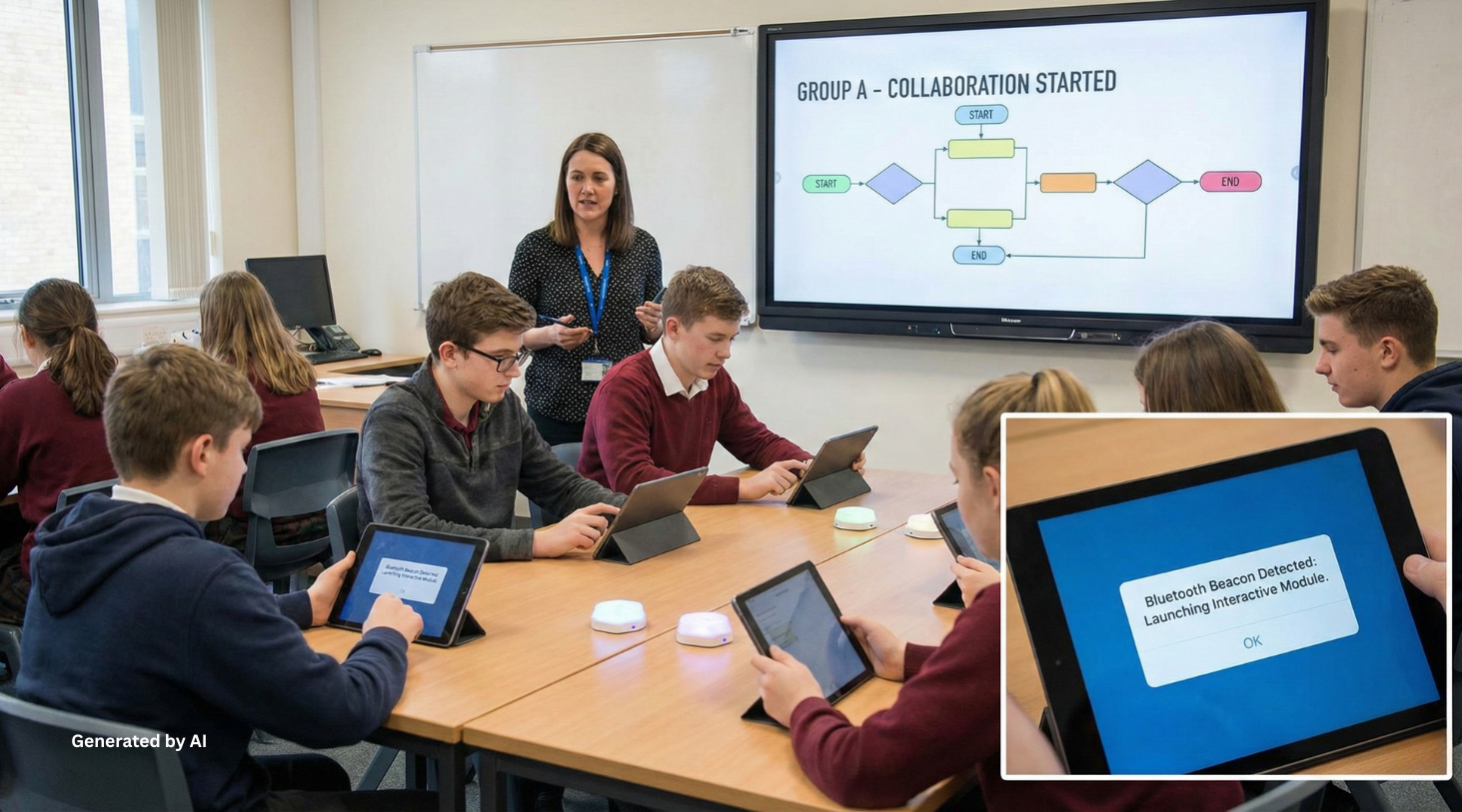
Bluetooth IoT in education delivers real value when it powers interactive learning workflows, not when it’s treated as a “cool gadget.” Think of Bluetooth Low Energy (BLE) as a lightweight stream of presence, proximity, and device-usage signals that your platform can convert into actions: onboarding, lesson progression, lab sessions, attendance, and assistive experiences.
Bluetooth provides the context. The SaaS layer turns that context into rules, content delivery, analytics, and integrations so teachers and admins get predictable outcomes instead of manual coordination. This is exactly where SaaS application development services matter: the product must be stable, secure, and practical in real classrooms.
From BLE signals to real learning interactions (how it works)
A production-ready interactive learning platform typically treats Bluetooth as an event source and keeps the “intelligence” in the platform:
-
BLE layer: beacons/tags in classrooms, smart lab kits, optional wearables for safety or accessibility needs;
-
Collectors: tablet/mobile scanning, fixed gateways, or edge hubs (for high-traffic areas);
-
Cloud backend: ingestion - event normalisation - rules engine - workflow orchestration;
-
Apps & dashboards: teacher/admin views, reporting, device health and usage insights;
-
Integrations: LMS/SIS/SSO, schedules, and notifications.
A strong SaaS development company designs Bluetooth to be “replaceable,” while keeping workflows reusable across classes and campuses. That’s the advantage of building with custom SaaS development services instead of shipping isolated pilots.
Examples of interactive tools you can build with Bluetooth IoT in education
1) Classroom zones that unlock the next learning step
Instead of navigating menus, students can progress through lessons based on proximity.
Example workflow:
-
The student enters a “reading station” zone.
-
The app opens the next activity.
-
Completion is saved to the platform.
Because the logic lives in the SaaS rules engine, teachers can reuse the same zone-based flow across classes and update it without changing devices.
2) Smart Lab Kits: Automatic Pairing + Usage Logging
Lab sessions often slow down when pairing is inconsistent, kits get mixed between groups, and teachers lose time to logistics. Bluetooth-enabled lab kits become managed digital resources when the platform logs usage automatically:
-
Which kit was used?
-
In which session/class?
-
By which group?
-
For how long?
-
With what outcome (submission/result)?
This is a common SaaS MVP development scope because it delivers measurable impact fast: less chaos, cleaner reporting, and repeatable lab sessions.
3) Station rotation workflows for hands-on classrooms
In STEM labs, language rooms, and special education settings, station rotation works best when the platform follows the student flow:
-
Station entry event: assignment opens.
-
Station exit event: progress is saved.
-
Teacher dashboard: live completion and bottlenecks.
Shipping this reliably often requires full-cycle software development because it spans mobile collection, backend orchestration, and real-time dashboards.
4) Attendance and participation signals without “heavy surveillance”
Attendance doesn’t need continuous tracking. For many institutions, minimal event signals are enough:
-
Entered zone;
-
Time in activity;
-
Task completed.
This supports automation with privacy-by-design, useful learning insights without collecting unnecessary personal data.
Where the SaaS layer adds real value (and why devices alone don’t solve it)
A basic BLE demo and a scalable EdTech product differ in what happens after the signal:
-
Signal quality: RSSI filtering, de-duplication, confidence scoring;
-
Workflow logic: rules engine and orchestration (“what triggers what”);
-
Access control: role-based flows for teacher/admin/student;
-
Multi-tenancy: school, district, campus configuration;
-
Integrations: LMS/SIS/SSO, notifications, reporting.
This is why teams choose a SaaS development agency: it’s not just connectivity, it’s productisation.
MVP scope that actually validates demand
Don’t “Bluetooth-enable everything.” Prove one interactive loop end-to-end:
-
1-2 learning zones or one smart kit workflow;
-
Simple teacher dashboard (live status + basic controls);
-
Basic reporting (participation + completion);
-
One integration (LMS import or roster sync).
This is the fastest way to validate Bluetooth IoT in education without overengineering and then scale confidently through a full-cycle roadmap.
Wireless Sensors and Data Loggers in Educational Labs
Bluetooth IoT in education becomes especially practical in science and engineering labs, where learning depends on measurement, repetition, and clean data. Wireless sensors and Bluetooth data loggers remove the friction of cables and manual note-taking: setup is faster, experiments are repeatable, and results can be stored, compared, and reviewed across groups.
But the real value shows up when lab telemetry becomes part of a SaaS learning workflow, not just a chart. With the right SaaS application development services, sensor data can flow into sessions, assignments, dashboards, grading logic, and exports, while staying simple for teachers and lab admins.
What “wireless lab data” should mean in a modern SaaS learning platform
In a lab environment, raw readings aren’t enough. A production-grade platform typically needs:
-
Reliable ingestion of Bluetooth telemetry (with buffering when devices disconnect);
-
Session-based logging (who measured what, when, and under which experiment template);
-
Data normalisation (units, sampling rates, calibration flags, device metadata);
-
Analytics + export (charts, CSV/PDF, comparisons across groups/classes);
-
Integrations with LMS/SIS for rosters, assignments, and grades.
This is why teams often hire a SaaS development company. The hard part is building the scalable platform around the sensor: data integrity, workflows, and integrations, not the BLE device itself.
Common Bluetooth sensors and data loggers used in education labs
Here’s a practical mapping you can use when planning the product scope.
|
Lab use case |
Typical Bluetooth device |
What students measure |
What the SaaS platform should store |
|
Chemistry experiments |
Temperature / pH sensors |
Reaction temperature curves, acidity changes |
Full time-series + experiment metadata (chemicals, steps, group) |
|
Physics & mechanics |
Accelerometer/ motion sensors |
Speed, acceleration, vibration |
Time-series + annotations (events, thresholds, trials) |
|
Biology/ environmental |
CO₂/humidity/air quality loggers |
Classroom or greenhouse conditions |
Long-term logs + comparisons across time and locations |
|
Electronics/ engineering |
Power/current/ voltage sensors |
Consumption patterns, load testing |
Sampling rate + device calibration + lab session results |
|
STEM robotics |
BLE telemetry modules |
Robot speed, motor load, distance |
Runs, failures, improvements across iterations |
How Bluetooth lab logging works (the minimal architecture that scales)
The key is to treat Bluetooth as local capture and SaaS as the system of record:
-
Sensor streams BLE readings (temperature, motion, etc.).
-
Tablet/mobile app collects signals, confirms session context, and buffers offline.
-
Cloud backend ingests events, normalises, and stores time-series data.
-
The teacher dashboard shows sessions, outcomes, and comparisons.
-
Export + integrations push results into LMS/SIS and reports.
To ship this reliably, you typically need SaaS app development services that consider cross-platform compatibility (shared school tablets, student devices, and intermittent Wi-Fi). One full-cycle team should own the workflow end-to-end, not only the UI.
Lab workflows that create “sticky” product value
If you want this section to drive leads, focus on workflows schools will actually pay for:
-
Experiment templates (repeatable labs)
Teachers define steps, sensor types, and expected ranges once; then reuse across classes. -
Guided data collection (less teacher overhead)
Students follow a structured flow:
-
start session;
-
record;
-
tag events;
-
submit.
This reduces errors and ensures that results are comparable.
-
Quality signals (not “perfect data”)
Bluetooth is noisy. A mature platform flags:
-
dropouts / low-confidence intervals;
-
calibration issues;
-
outliers vs expected ranges.
That’s what separates a demo from a production-ready EdTech SaaS product.
MVP recommendation for a lab data logger feature (no overbuild)
For example, to prevent the problem of scope explosion, an SaaS MVP model should be developed in the context of a single lab domain, such as chemical temperature and pH values for chemistry, or motion for physics:
-
1 sensor category + 1-2 experiment templates;
-
session logging + basic charting;
-
teacher dashboard for reviewing + exporting;
-
class roster import or LMS integration.
The above MVP is sufficient for validating adoption, and then further development work in SaaS product development services can be carried out for multi-sensor packs, long-term environment monitoring, and comprehensive reporting.
Accessibility Tech in Education: Bluetooth Devices for Inclusive Learning
Bluetooth IoT in education isn’t only about “smart classrooms.” In many schools, the highest-impact use cases are accessibility and inclusive learning, where Bluetooth-enabled assistive devices help students participate with less friction and more independence. Because Bluetooth Low Energy is power-efficient and widely supported across tablets and phones, it’s a practical foundation for scalable accessibility workflows.
The real value, however, isn’t in the device alone; it’s in the SaaS layer. With the right SaaS development services, Bluetooth accessibility devices can become part of a consistent learning experience: profiles follow the student, teachers can configure accommodations quickly, and admins can support deployment across multiple classes or campuses.
Where Bluetooth accessibility devices fit
Common categories of Bluetooth assistive technology in education include:
-
Alternative input: switches, adaptive buttons, simplified controllers;
-
Typing aids: ergonomic keyboards, simplified input devices;
-
Audio accessibility: classroom audio receivers, hearing support accessories;
-
Routine and attention support: wearables with haptic cues and silent prompts.
These devices are useful, but only if the platform can reliably pair them, apply settings, and deliver accessible UI flows at scale.
What an inclusive SaaS platform should handle
A scalable platform built with SaaS app development services should cover five practical capabilities:
-
Fast onboarding for shared devices.
Predictable pairing, managed reconnect, and admin controls because tablets get reassigned constantly. -
Student accessibility profiles that “follow the learner”.
Device mappings and settings persist across classes and hardware (e.g., switch mappings, scanning speed, audio routing). -
Teacher-friendly configuration.
Templates + role-based access so teachers can apply accommodations without touching system settings or fighting Bluetooth menus. -
Accessible content delivery by default.
Keyboard/switch-first flows, clear UI states, captions/transcripts, and consistent navigation patterns. -
Privacy-first analytics.
Progress and engagement signals without collecting sensitive health data, supporting privacy-by-design and compliance.
|
Need |
Bluetooth device example |
SaaS platform should support |
|
Limited mobility |
Switch/adaptive button |
Switch-friendly UI mode, scanning settings, per-student profiles |
|
Hearing support |
Audio receiver/accessory |
Audio routing presets, caption defaults |
|
Focus & routine |
Wearable (haptic alerts) |
Schedules, nudges, teacher-configurable routines |
|
Inclusive assessments |
Adaptive input devices |
Assessment mode + accommodations per student |
Building a Bluetooth IoT SaaS Platform for Education
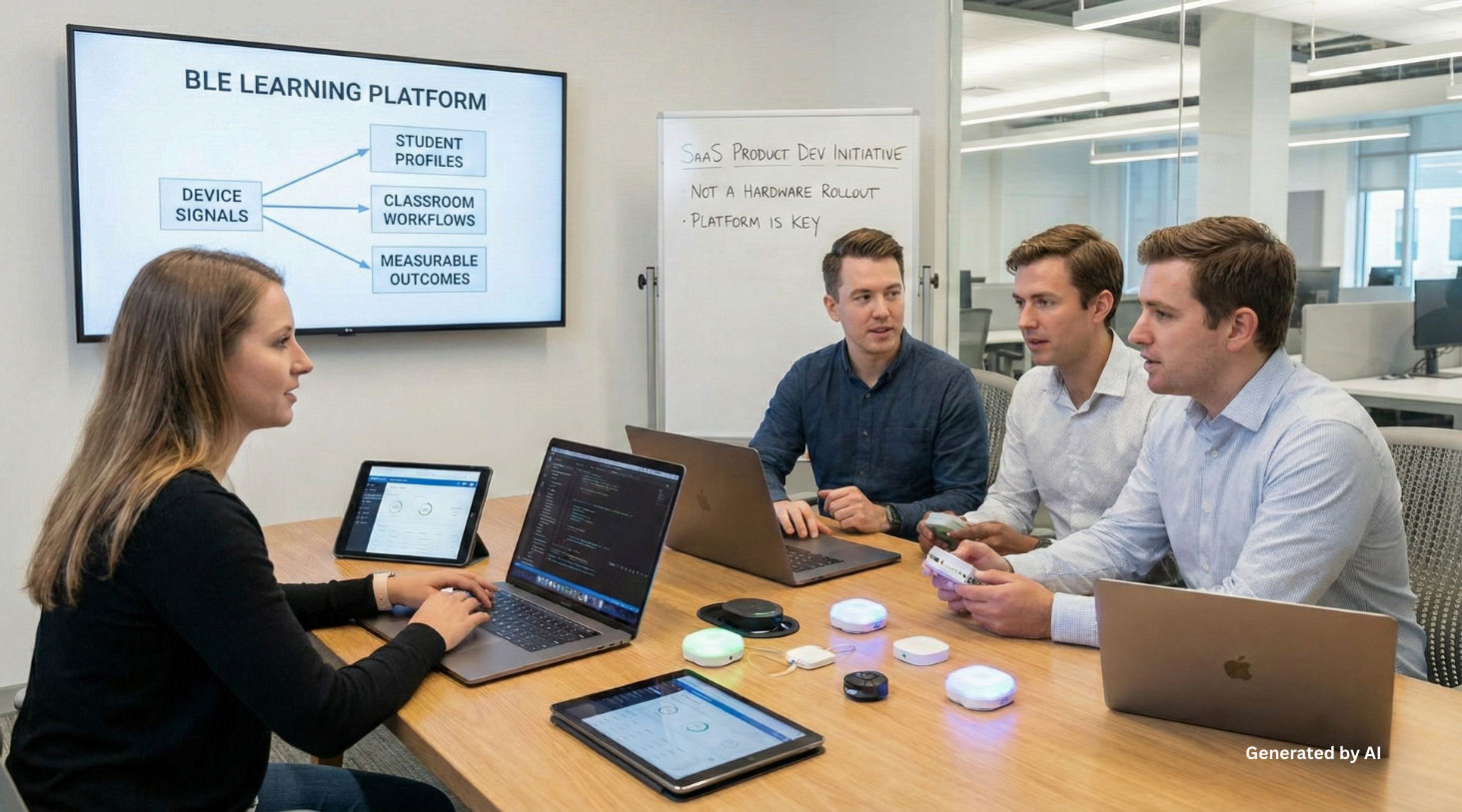
A Bluetooth IoT learning system only becomes “real” when device signals are embedded into the full learning lifecycle: onboarding, student profiles, classroom workflows, and measurable outcomes. That’s why most institutions treat this as a SaaS product development initiative (not a hardware rollout): the platform is what turns BLE events into usable experiences for teachers, students, and administrators.
For EdTech teams, this typically means working with a SaaS development company that can deliver the full chain:
-
discovery;
-
SaaS MVP development;
-
production hardening;
-
scaling across campuses.
1. What you’re actually building (platform scope)
A production-ready Bluetooth IoT platform for education usually includes:
-
Device layer (Bluetooth IoT): switches, wearables, sensors, audio accessories, lab data loggers;
-
Edge layer (optional): classroom hub/gateway for weak Wi-Fi, offline buffering, and stable ingestion;
-
Cloud backend: ingestion, event processing, profile management, permissions, and data retention;
-
Apps: teacher web dashboard, student tablet/mobile app, admin console;
-
Integrations: LMS (Google Classroom, Moodle, Canvas), SIS (rosters), and SSO (identity).
This is the core of SaaS application development solutions for education: Bluetooth is the input; the platform is the product.
2. Reference architecture (practical and scalable)
A practical reference architecture looks like this:
-
Bluetooth Devices;
-
Mobile/Edge Collector;
-
Cloud Ingestion API;
-
Event Processing;
-
Storage;
-
Rules & Analytics;
-
Apps & Integrations.
Key building blocks to include from day one:
-
Device registration + pairing management (shared tablets, fast re-pairing, controlled access);
-
Student accessibility profiles (settings follow the learner across devices and classes);
-
Rules engine (alerts, routines, zone rules, time-based prompts);
-
Multi-tenancy (district, school, class with tenant-level configuration);
-
RBAC + audit logs (compliance, accountability, admin/teacher boundaries);
-
Observability (device health, gateway status, event latency, pairing failures).
This is where full-cycle web development matters most: reliability, security, and maintainability are platform features, not “later improvements.”
3. MVP roadmap (what to build first)
A strong SaaS MVP focuses on 1-2 high-leverage use cases, shipped end-to-end:
Recommended MVP options:
-
Accessibility MVP: Bluetooth switch support + per-student profiles + teacher configuration;
-
Lab MVP: data logger ingestion + charts + export to LMS/reporting;
-
Classroom tools MVP: interactive BLE triggers + session controls + basic analytics.
Typical MVP deliverables:
-
Pairing and onboarding flows (shared devices);
-
Teacher dashboard (web);
-
Student “mode” for tablets/mobile;
-
Cloud event pipeline + storage;
-
One integration (LMS or SSO).
This is the sweet spot for SaaS application development services: enough platform depth to validate adoption, without turning the MVP into a multi-year build.
4. Implementation steps (full-cycle delivery)
If you engage a full-cycle software development company, a realistic delivery flow looks like:
-
Discovery + SRS (2-4 weeks)
Use cases, device map, data model, privacy rules, integrations, and success metrics. -
Build the MVP (8-14 weeks)
Core flows + one classroom pilot, with an emphasis on onboarding stability. -
Production hardening (8-16 weeks)
Multi-tenancy, RBAC, audit logs, monitoring, security, and performance. -
Scale rollout (ongoing)
More device types, more schools, deeper analytics, and more LMS/SIS integrations.
This is the difference between “a pilot that works once” and SaaS software development services that create a repeatable platform.
5. Budget & timeline table
|
Phase |
Scope |
Typical timeline |
Typical budget |
|
Discovery & SRS |
Use cases, device map, integrations, data/privacy requirements |
2-4 weeks |
$5,000-$15,000 |
|
SaaS MVP |
Pairing + core workflows + dashboard + basic analytics + 1 integration |
2-3.5 months |
$30,000-$70,000 |
|
Production platform |
Multi-tenancy, RBAC, audit logs, monitoring, security hardening |
2-4 months |
$60,000-$150,000 |
|
Ongoing ops |
Cloud, support, iteration, device onboarding, roadmap delivery |
monthly |
$2,000-$10,000 / month |
These ranges assume a professional team providing custom SaaS development services (design + backend + web + mobile + QA + DevOps).
6. What makes or breaks an education IoT SaaS rollout
These are the non-negotiables that determine whether the platform survives real school operations:
-
Rapid onboarding for shared devices (hardware is reassigned constantly);
-
Offline buffering + event reconciliation (Wi-Fi drops happen daily);
-
Privacy-by-design (minimise sensitive data, role-based visibility);
-
Supportability (device health dashboards, pairing logs, remote troubleshooting).
That’s why many teams choose custom SaaS development services from a single vendor: fragmented delivery (devices here, dashboards there, integrations elsewhere) creates operational debt that kills adoption.
From Pilot Projects to Scalable EdTech SaaS Products
The typical error of most of the Bluetooth IoT pilot projects for educational institutes is that they are able to prove the usefulness of their products, but not that they can implement their SaaS solution without disrupting the business model of onboarding, support, and security.
To achieve success from “cool demo to repeatable business model in EdTech,” one would also have to apply the same rigour as in developing SaaS services, such as multi-tenancy, role-based access, and support for functionality, which is possible by a SaaS development company.
What “scalable” means in EdTech SaaS (not just “more devices”)
An effective and scalable solution for the development of a SaaS application with Bluetooth IoT in education may comprise the following:
-
Multitenancy: district - school - class, with tenant-level configs;
-
Role-based: admin/teacher/assistant; activities on the devices are traceable through audit logs;
-
Device lifecycle management process: enrol - assign - reassign - retire (shared tablets are the default mode for schools);
-
Standard Integration Descriptions: SSO + LMS (to prevent the management of users by hand);
-
Support tooling: Device Health Dashboard, Pairing Logs, Offline Buffers, Incident History;
-
Rollout playbook: training, templates, “first lesson” flows, and measurable success KPIs.
This is precisely where services for developing software through SaaS create the most value: a functional platform that becomes operable is established.
Concrete example: Accessibility platform using Bluetooth switch devices
Goal: help students with motor impairments use learning apps via Bluetooth switches (single/dual switch), with settings that follow the student across devices.
Pilot setup (6-8 weeks)
- 1 school, 3 classes, ~25 students;
- 10 Bluetooth switches, 15 tablets, 2 teacher dashboards.
Features shipped as a SaaS MVP:
-
-
Student profiles (switch mapping, scanning speed, dwell time);
-
Teacher web dashboard to configure profiles + assign devices;
-
Tablet app “student mode” (locked session + quick reconnect);
-
Cloud event logs (usage + session success rate).
-
Pilot KPI targets
-
Onboarding time per device: < 5 minutes;
-
Reconnect success rate: > 95%;
-
Teacher setup time per student: < 2 minutes;
-
Weekly active usage: > 70% of targeted students.
What breaks when you scale (and what the SaaS layer fixes)
When they expand to more schools, the problems aren’t “Bluetooth range” - they’re operational:
-
Tablets get reassigned daily: need device assignment + fast reprovisioning;
-
Multiple teachers touch the same class: need RBAC + audit trail;
-
Different schools want different defaults: need tenant-level configuration.
-
Support tickets explode: need health dashboards + logs + remote diagnostics
So the next phase of custom SaaS development services adds:
-
Multi-tenancy (district/school/class);
-
Roles + permissions + audit logs;
-
Pairing history + device health monitoring;
-
Offline buffering (if Wi-Fi drops);
-
LMS + SSO integration (auto-provision teachers/classes).
Rollout outcome (3-4 months after pilot)
-
Scale to 10 schools, ~300 students, 120 tablets, ~80 switches;
-
Support load stays manageable because:
-
pairing issues are traceable in logs;
-
device health surfaces battery/connection problems early;
-
teachers can self-serve most configuration tasks.
Why does this become a product (not a project)
Now the platform can be sold as a repeatable EdTech SaaS offering:
-
predictable onboarding;
-
secure access controls;
-
multi-school management;
-
measurable outcomes for admins and stakeholders.
Here is the distinction between “pilot projects” and the development of a SaaS product using a full-cycle development method.
Join.To.IT is involved in such projects and is tasked with a Bluetooth IoT education project that goes from a pilot project to a scalable SaaS product for the EdTech industry. This includes the whole range from the development of SaaS MVP to the architectural design and development of the web and mobile applications.
If you require validation of demand and then scale to a production-level platform, Join.To.IT can be your end-to-end software development service provider for Bluetooth IoT + SaaS in education.