

Dental Software Development: From Practice Management Systems to Multi-Tenant SaaS
Modern dental software development is moving from standalone practice management tools toward cloud platforms that support multiple clinics, user roles, workflows, and locations. Traditional dental practice management software usually covers appointments, patient records, treatment information, billing, and communication for a single practice. The requirements change when the product must support dental groups, DSOs, franchise networks, or multiple independent clinics.
Cloud-based dental systems increasingly centralize data and workflows across locations instead of requiring each office to run a separate installation. Platforms such as Dentrix Ascend already emphasize centralized access, multi-location management, analytics, and standardized workflows.
When a Dental Practice Management System Becomes a SaaS Product
A dental SaaS platform is more than practice management software hosted in the cloud. It must serve multiple organizations while keeping their users, permissions, settings, patients, workflows, and business data separated.
This requires:
-
organization and location management;
-
role-based permissions at both organization and clinic level;
-
logical data isolation between customers;
-
consolidated reporting across locations;
-
tenant-specific configuration without separate codebases;
-
centralized product updates;
-
infrastructure that scales with new clinics, users, and workloads.
This is where custom dental software development differs from building a conventional practice management application. The product becomes a shared platform with tenant management, centralized administration, configurable access, subscriptions, and scalable infrastructure.
Multi-location systems already show part of this model. Open Dental practice management software, for example, supports multiple clinic locations within a shared database while keeping location-specific reporting and user access separate. A SaaS product extends this approach to multiple independent customer organizations.
Multi-Tenancy Changes the Technical Foundation
For an AI-powered dental SaaS platform, multi-tenancy should be part of the architecture from the start rather than added after the MVP.
Each request must carry the correct tenant context so users can access only the resources assigned to their organization. Depending on compliance, performance, scale, and cost requirements, multi-tenant dental SaaS may use shared resources with logical data separation, dedicated resources for specific tenants, or a hybrid model.
The platform should also separate the tenant from individual clinic locations. A dental group may be one tenant with many clinics underneath it, while users can receive access to the entire organization, selected locations, or specific roles.
From Clinic Software to a Scalable Dental SaaS Platform
Moving from dental practice management software to SaaS allows one product to serve many customers without maintaining separate deployments for every clinic.
It also creates the foundation for:
-
cross-location analytics;
-
centralized integrations;
-
mobile access;
-
automated workflows;
-
AI services;
-
subscription management;
-
organization-level administration.
A modern dental software development strategy should therefore define tenant structure, data boundaries, organization hierarchy, and scalability early. If the product is intended for multiple practices or subscription-based distribution, these decisions should be built into the platform before the feature set expands.
The result is not simply cloud-based dental software, but a scalable platform that can serve multiple dental organizations while keeping their data and workflows separated.
Core Features of an AI-Powered Dental SaaS Platform
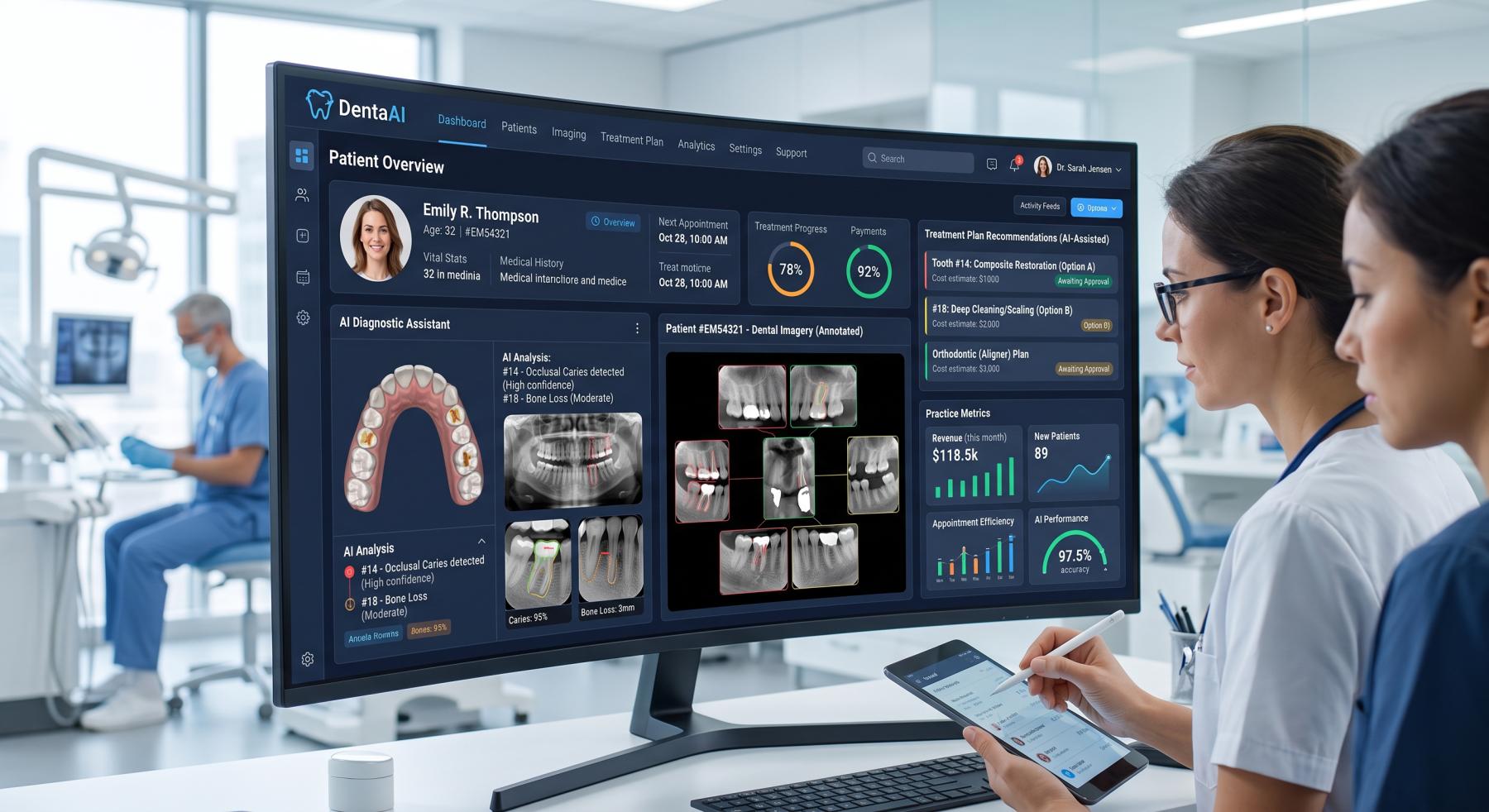
An AI-powered dental SaaS platform should cover the clinical, administrative, and financial workflows dental teams use every day. Its core functionality typically includes patient records, treatment planning, scheduling, billing, insurance workflows, imaging, patient communication, and AI-assisted clinical or operational tools.
Clinical Records and Treatment Planning
The clinical layer should give dentists one place to manage patient history, tooth charts, procedures, treatment plans, clinical notes, and related images.
Key capabilities include:
-
digital patient records and medical history;
-
graphical dental charting;
-
treatment plan creation and prioritization;
-
procedure and treatment status tracking;
-
fee and insurance estimates;
-
access to radiographs and other clinical images.
Treatment planning can also connect procedure data with fees, insurance estimates, preauthorization, and lab cases. This helps reduce duplicate data entry and keeps clinical and financial information consistent throughout the patient journey.
Scheduling, Patient Communication, and Payments
Administrative features should support the full visit cycle before and after treatment.
Useful capabilities include:
-
online appointment scheduling with real-time availability;
-
appointment confirmations and automated reminders;
-
digital forms and patient intake;
-
treatment plan presentation;
-
billing and payment tracking;
-
insurance estimates and preauthorization workflows;
-
email or messaging for patient communication.
For custom dental software development, these workflows should reduce manual work for front-desk teams and make it easier to coordinate scheduling, treatment, billing, and follow-up.
AI Dental Imaging and Clinical Decision Support
One of the most practical areas of AI dental software development is radiograph analysis. AI can assist with reviewing dental X-rays, highlighting potential findings such as caries or bone loss, measuring structures, and adding visual annotations for clinician review.
AI can also support:
-
image quality checks;
-
treatment planning by surfacing relevant findings;
-
patient education with annotated radiographs;
-
insurance verification;
-
claim documentation review;
-
detection of missing information before claim submission.
The most useful AI features are embedded directly into existing workflows. Imaging analysis should appear where clinicians review radiographs, while insurance automation should use existing patient and treatment data.
This makes AI part of the daily workflow rather than a standalone add-on and gives the dental SaaS platform measurable value through faster review, less manual administration, and better use of clinical data.
AI Dental Software Development: Imaging, Clinical Notes, and Workflow Automation
In AI dental software development, AI components should be separated from the core application so they can be tested, replaced, and scaled independently. The technical focus is on service orchestration, structured data processing, validation, fallback logic, and model observability.
Design an AI Service Layer
A production architecture can separate the application from external AI providers through an orchestration layer:
Dental application - AI orchestration service - provider adapter - model
The orchestration service can handle model selection, input validation, prompt or configuration versions, routing, and structured responses.
This allows the system to:
-
use different models for imaging, transcription, and text generation;
-
switch providers without rewriting core application logic;
-
route requests based on latency, cost, or model capability;
-
introduce fallback providers;
-
test new model versions independently.
This abstraction is especially useful in custom dental software development, where AI providers and model capabilities may change faster than the core product.
Build an Asynchronous Dental Imaging Pipeline
Image processing should generally run as a background job rather than inside a long synchronous request.
A typical pipeline can be:
Image upload - validation - preprocessing - job queue - AI inference - output validation - storage - review state
Before inference, the system can validate file type, resolution, metadata, and image quality. Background workers can then process multiple images without blocking the user interface.
AI results should be stored separately from the original image and returned in a structured format containing fields such as:
-
detected regions;
-
labels;
-
measurements;
-
confidence scores;
-
model version;
-
processing timestamp.
This structure makes results easier to audit, compare, and reprocess when the model changes.
Create a Structured Clinical Notes Pipeline
Instead of saving a free-form model response, generated content can be mapped into predefined fields for findings, procedure details, materials, recommendations, and follow-up instructions.
Structured outputs can be validated against JSON schemas or application-level data models before being written to the database.
Version history should record:
-
original input;
-
model and prompt version;
-
generated draft;
-
manual edits;
-
approved version.
This makes generated documentation traceable and easier to audit.
Keep Workflow Logic Outside the Model
AI should handle interpretation, extraction, classification, or generation, while deterministic application logic controls predictable actions.
A workflow engine can define:
-
when an AI service is triggered;
-
which model processes the task;
-
required confidence thresholds;
-
retry limits;
-
timeout behavior;
-
fallback routes;
-
conditions that require manual approval.
Keeping these rules outside the model prevents critical application behavior from depending entirely on probabilistic output.
Add Validation and Fallback Logic
AI output should be validated before it changes stored data or advances a workflow.
Validation can include:
-
schema checks;
-
confidence thresholds;
-
required-field validation;
-
consistency checks;
-
duplicate detection;
-
approval states for uncertain results.
If a model fails, times out, or returns invalid data, the system should retry the request, switch providers, or route the task to a manual process rather than fail silently.
Monitor Model Performance and Cost
AI services need dedicated observability.
Useful production metrics include:
-
inference latency;
-
error and timeout rates;
-
model version;
-
approval and rejection rates;
-
manual correction rate;
-
fallback frequency;
-
token or inference usage;
-
cost per processed task.
These metrics help identify regressions, compare providers, and control operating costs.
For scalable AI dental software development, the AI layer should therefore be modular, observable, and independent from the core application. This makes it possible to update models, providers, and processing pipelines without redesigning the rest of the product.
Dental SaaS Architecture: Multi-Tenancy, Data Isolation, and Scalability
A production dental SaaS architecture should enforce tenant context across API requests, databases, storage, caches, background jobs, and monitoring. The technical goal is to ensure that every operation is scoped to the correct dental organization while the platform can scale without creating performance conflicts between tenants.
Resolve Tenant Context at the Application Boundary
Every authenticated request should be mapped to a tenant before business logic is executed. Tenant context can include:
-
tenant_id;
-
clinic or location ID;
-
user role and permissions;
-
subscription tier;
-
enabled modules.
The backend should propagate this context through downstream services rather than relying on client-side filters. Database queries, object storage paths, cache keys, and background jobs should all use the same tenant identifier.
This reduces the risk of cross-tenant access caused by missing filters or incorrectly scoped requests.
Design the Database Around Tenant Access
In shared database environments, tenant identity should be part of the data model rather than added only at the application layer.
Common practices include:
-
adding tenant_id to tenant-owned tables;
-
creating indexes that include the tenant identifier;
-
preventing database queries without tenant scope;
-
separating platform-wide data from tenant-owned clinical and operational data;
-
including tenant context in audit logs and background jobs.
If the platform uses separate databases for selected customers, it also needs a tenant directory that maps each organization to the correct database or connection configuration.
For custom dental software development, this becomes especially important when a single platform must support both smaller practices and large dental organizations with different data and performance requirements.
Prevent Noisy-Neighbor Problems
Shared infrastructure creates a risk that one tenant may consume enough resources to affect others.
A scalable dental SaaS platform can control this through:
-
per-tenant API rate limits;
-
job and request quotas;
-
concurrency limits;
-
database connection limits;
-
workload prioritization;
-
tenant-aware caching;
-
resource limits based on subscription tier.
For example, large report generation, bulk data imports, or analytics workloads should not reduce the performance of scheduling or patient-record operations for other customers.
Scale Services Independently
Different workloads should be able to scale independently instead of forcing the entire platform to scale as one unit.
Stateless API services can scale horizontally, while heavier components can run as separate services or background workers, such as:
-
reporting;
-
document processing;
-
notifications;
-
analytics;
-
exports and imports.
This allows infrastructure capacity to follow actual demand and keeps high-load operations from competing with critical application workflows.
Make Caching and Background Jobs Tenant-Aware
Tenant context should also be included outside the primary database.
Cache keys can include tenant_id to prevent one organization's cached data from being returned to another. Background jobs should carry tenant metadata so workers can retrieve the correct configuration, permissions, and data scope when processing asynchronous tasks.
The same principle applies to object storage. File paths, metadata, and access policies should make tenant ownership explicit rather than relying only on application-level conventions.
Add Tenant-Level Observability
Logs and infrastructure metrics should include tenant context so operational issues can be traced to a specific customer or workload.
Useful tenant-level metrics include:
-
API latency;
-
request volume;
-
database usage;
-
storage consumption;
-
failed operations;
-
background-job duration;
-
error rates;
-
resource utilization.
This makes it easier to determine whether a performance issue affects the entire platform or only one dental organization.
Plan Backup and Recovery at Tenant Level
Backup architecture should define how data can be restored without affecting unrelated customers.
Depending on the database model, the platform may need to support:
-
full database recovery;
-
point-in-time restoration;
-
recovery of a single tenant;
-
recovery of selected records or files.
Tenant identifiers should remain consistent across databases, storage, logs, and backups so restored data can be mapped back to the correct organization.
For scalable dental software development, strong architecture therefore depends on tenant-aware request handling, database design, workload controls, caching, observability, and recovery processes. These mechanisms allow a multi-tenant dental SaaS platform to grow while maintaining predictable performance and strict separation between customer data.
Dental Software Integrations, HIPAA Compliance, and Data Security

A dental SaaS platform often needs to exchange data with imaging systems, insurers, payment providers, laboratories, EHR platforms, and patient-facing applications. In dental software development, these integrations should be built through controlled interfaces that limit how external systems access and process patient data.
Build an Integration Layer for External Systems
Connecting every third-party service directly to core application logic makes the platform harder to maintain. A dedicated integration layer can handle:
-
API authentication and credential management;
-
data mapping and transformation;
-
webhook processing;
-
retries and timeout handling;
-
API version changes;
-
failed-message queues;
-
connector-specific monitoring.
This allows individual integrations to be updated without changing unrelated product logic.
Healthcare data exchange may also require industry standards. FHIR, developed by HL7, provides a standardized framework for exchanging electronic healthcare information. Dental imaging systems can rely on DICOM for image storage and communication, while insurance workflows may use transactions such as the HIPAA-standard 837D electronic dental claim.
For a dental SaaS product, supporting these standards can reduce the amount of custom mapping required when connecting to external healthcare systems.
Define How ePHI Moves Through Integrations
HIPAA becomes relevant when a dental software provider creates, receives, maintains, or transmits protected health information on behalf of a covered dental organization.
Before an integration is implemented, the development team should define:
-
what patient data is transmitted;
-
which external service receives it;
-
why that information is required;
-
whether the data is stored by the provider;
-
how long it is retained;
-
whether the provider can use it for secondary purposes;
-
how the data is deleted after the integration is disconnected.
Only the information required for a specific workflow should be transmitted. For example, an appointment reminder service does not need access to a complete clinical record, while a claims integration may require treatment, insurance, and billing data.
Encrypt Sensitive Data in Transit and at Rest
Patient information should be protected both when stored and when transmitted between systems.
Typical controls include:
-
TLS for API and browser traffic;
-
encryption for databases and object storage;
-
secure management of encryption keys;
-
encrypted backups;
-
secrets management for API keys and service credentials.
External integrations should use scoped credentials rather than shared master credentials. Tokens should be revocable and limited to the specific APIs or data required by the integration.
Manage Business Associate Agreements and Vendor Risk
If a third-party provider handles ePHI on behalf of a dental practice or its software vendor, it may qualify as a business associate under HIPAA. In these cases, a Business Associate Agreement (BAA) may be required.
This means cloud infrastructure, messaging providers, document services, AI APIs, analytics tools, and other vendors should be evaluated before they are added to the production data flow.
A vendor review should cover:
-
BAA availability;
-
data storage location;
-
encryption practices;
-
retention and deletion policies;
-
subcontractors;
-
incident notification procedures;
-
access to customer data;
-
security certifications where relevant.
This is particularly important for AI dental software development, because external AI services may receive clinical text, images, or other sensitive patient information.
Apply Data Minimization to Third-Party APIs
Integrations should not automatically receive complete patient objects or unrestricted database access.
Instead, the platform can create integration-specific payloads that contain only the fields required for the transaction. For example:
-
an insurer may receive procedure and policy information;
-
a payment provider may receive transaction data without clinical notes;
-
an imaging service may receive the relevant image and identifiers without unrelated billing information.
This reduces the amount of sensitive information exposed if an external service is compromised and makes data flows easier to document and review.
Plan for Security Incidents Across Connected Services
A security strategy should also define what happens if a third-party integration is compromised or begins returning suspicious data.
The platform should be able to:
-
revoke API credentials;
-
disable an integration without taking the core system offline;
-
identify which patient records were affected;
-
trace outbound requests to the external service;
-
rotate secrets and tokens;
-
preserve evidence required for incident investigation.
For custom dental software development, integrations should therefore be treated as controlled security boundaries rather than simple API connections. Standards-based data exchange, data minimization, encryption, vendor assessment, and clear ePHI handling rules help a dental SaaS platform connect to external healthcare systems without creating unnecessary exposure of patient information.
Dental Software Development Cost: MVP Roadmap and Platform Scaling
The dental software development cost depends on product scope, number of platforms, integrations, AI functionality, compliance requirements, and the complexity of clinical and administrative workflows. A focused MVP can be launched with a relatively limited feature set, while a full dental SaaS platform for multiple practices or enterprise customers requires a much larger investment.
|
Development stage |
Example scope |
Approximate budget |
|
Discovery and prototype |
Product requirements, UX flows, architecture planning, clickable prototype |
$3,000-$8,000 |
|
Dental SaaS MVP |
Patient management, scheduling, basic clinical records, billing, admin panel |
$13,000-$26,000 |
|
Advanced SaaS product |
Patient portal, mobile app, insurance workflows, payments, third-party integrations |
$26,000-$50,000 |
|
AI-powered dental platform |
AI features, advanced automation, model integration, monitoring |
$40,000-$73,000+ |
|
Enterprise dental SaaS |
Advanced reporting, enterprise configuration, large-scale integrations and customization |
$66,000-$133,000+ |
These ranges are useful for early planning but should not be treated as fixed prices. The final estimate depends on the exact feature set, development model, integration requirements, and expected product scale.
Define the MVP Around One Core Workflow
A dental SaaS MVP should validate the main product value before the team invests in a complete platform.
For example, a new dental practice management product may initially include:
-
patient profiles;
-
appointment scheduling;
-
basic clinical records;
-
treatment information;
-
staff management;
-
billing;
-
administration tools.
Features such as a patient mobile app, advanced insurance workflows, complex third-party integrations, or AI functionality can be moved to later releases if they are not essential for initial product validation.
A phased roadmap may look like this:
Phase 1 - MVP: launch the core workflow and validate it with real dental practices.
Phase 2 - Product expansion: add patient-facing functionality, payments, communication tools, and additional operational features.
Phase 3 - AI and automation: introduce selected AI capabilities where they can reduce manual work or improve product value.
Phase 4 - Enterprise growth: add advanced configuration, analytics, additional integrations, and features required by larger customers.
This approach makes custom dental software development easier to budget because each development stage has a clear objective and measurable scope.
What Has the Biggest Impact on Development Cost
Two products with a similar number of screens can have very different development budgets.
The main cost drivers usually include:
-
web-only versus web and native mobile applications;
-
number and complexity of user workflows;
-
custom integrations with external dental or healthcare systems;
-
legacy data migration;
-
insurance and payment workflows;
-
custom analytics and reporting;
-
AI functionality;
-
security and healthcare compliance requirements;
-
product customization for enterprise clients.
For example, adding a simple patient portal to an existing platform may require a limited extension of the product. Building a separate iOS and Android application with patient scheduling, notifications, payments, and access to clinical information creates a much larger scope.
The same applies to AI. A narrowly defined AI assistant can be considerably cheaper than developing several AI-powered workflows that require custom processing, evaluation, and ongoing model usage.
Budget Platform Scaling as a Separate Stage
Scaling should have its own development and infrastructure budget rather than being hidden inside the initial MVP estimate.
As adoption grows, additional spending may be required for:
-
higher cloud infrastructure usage;
-
performance optimization;
-
additional QA and automated testing;
-
DevOps and deployment automation;
-
monitoring and support;
-
new enterprise requirements;
-
continuous product development.
This makes the total cost of ownership more realistic than estimating only the first release.
Dental Software Development with JoinToIT
JoinToIT can support the full dental software development lifecycle, from early product discovery to MVP development and further platform growth.
Depending on the project, the team can cover:
-
product discovery and technical planning;
-
UX/UI design;
-
web and mobile application development;
-
backend development;
-
SaaS architecture;
-
third-party integrations;
-
AI functionality;
-
quality assurance;
-
deployment and ongoing development.
Instead of estimating an entire dental platform as one large project, JoinToIT can divide development into clear stages with separate scope, priorities, and budgets.
For a startup, this may mean launching a focused dental SaaS MVP first and expanding it after product validation. For an established dental organization, development can start from a broader scope that includes existing workflows, system integrations, data migration, and enterprise requirements.
A phased approach keeps the initial investment focused while providing a clear path from MVP to a mature dental SaaS platform.
We build custom dental practice software and the multi-tenant SaaS platforms that serve several clinics from one product.