
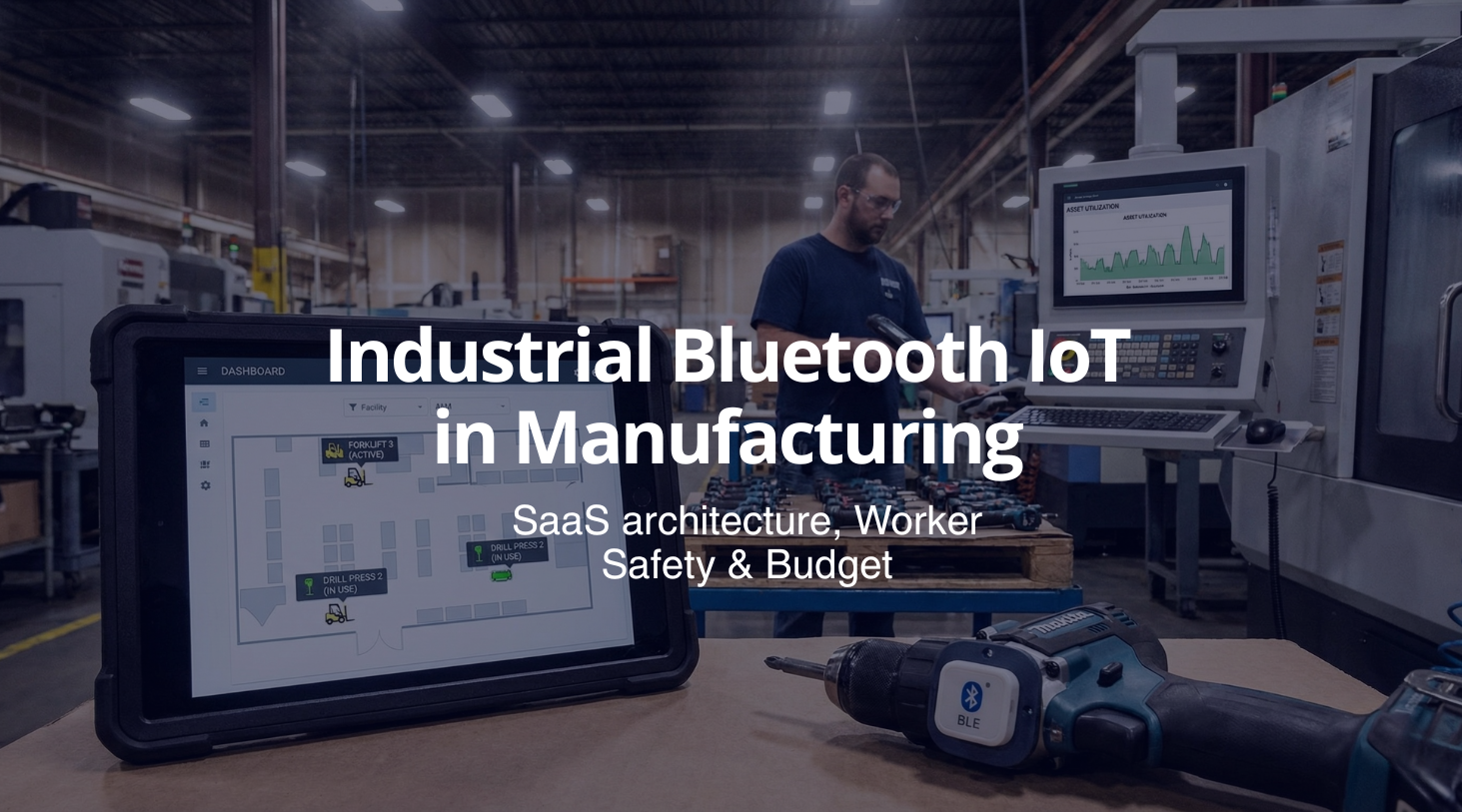
Industrial Bluetooth IoT Solutions: What They Are and Why Manufacturing Needs Them
Industrial Bluetooth IoT in manufacturing combines Bluetooth-enabled devices, industrial sensors, and a cloud-based SaaS platform to provide manufacturers with real-time insights into assets, machinery, and workers. This includes location tracking, usage patterns over time, and staff safety.
From a technology perspective, these solutions are not only about hardware. Most of the value comes from the SaaS layer, which turns Bluetooth data from tags, wearables, and sensors into dashboards, alerts, and integrations with existing systems such as ERP, MES, or CMMS.
It’s not surprising that companies are turning to a SaaS development company for services related to Bluetooth IoT, rather than considering it a standalone device.
Why Bluetooth IoT Fits Industrial and Manufacturing Environments
Bluetooth solutions are particularly well-suited to industry applications where functional range, price, and accurate performance are essential. In practice, Bluetooth trackers and sensors are highly effective and can run for years without needing a battery change, whereas GPS and other wireless solutions typically require replacement relatively frequently.
When combined with industrial IoT software delivered through the SaaS model, Bluetooth makes the following possible:
-
Continuous tracking of assets such as tools, equipment, and mobile machinery.
-
Predictive maintenance via sensor-based condition monitoring.
-
Worker safety and health monitoring through wearable technology and location alerts.
This data flows into the SaaS analytics layer, where it’s visualised, analysed, and connected to ERP, MES, or maintenance systems.
From IoT Devices to a SaaS Platform
Modern manufacturers don't want isolated systems. They need platforms that grow with their operations. That is why industrial Bluetooth IoT solutions are increasingly built as custom SaaS products, not some internal tools.
A typical solution developed by an engineering team includes:
-
A cloud backend for the ingestion and processing of Bluetooth events.
-
Web dashboards for operational, safety, and management teams.
-
Mobile apps for on-site staff.
-
Secure APIs that connect the IoT platform with enterprise systems.
This allows companies to do SaaS MVP development on a small scale, use case validation in a pilot environment, and then scale across multiple sites, factories, or even external customers.
Why Manufacturing Needs SaaS-Based IoT Now
Industrial factories face the challenges of minimising downtime, optimising safety, and maximising efficiency with less complexity. Existing solutions, spreadsheets, or manual checks cannot cope with the ever-changing industrial scenario.
The IoT platform developed using Bluetooth technology and custom SaaS development services benefits companies in various ways, including:
-
Automating asset verification through real-time tracking.
-
Predicting potential machine failures before they happen.
-
Rapidly responding to safety incidents.
-
Scaling operations without rewriting software for each new site.
These solutions are maintained, secured, and scalable.
In conclusion, industrial Bluetooth IoT solutions are no longer R&D projects. With proper planning, development, and execution as a full-cycle software services delivery process, they can become a strategic solution to manufacturing performance, safety, and growth.
Bluetooth Asset Tracking in Manufacturing: Real-Time Control of Equipment and Tools
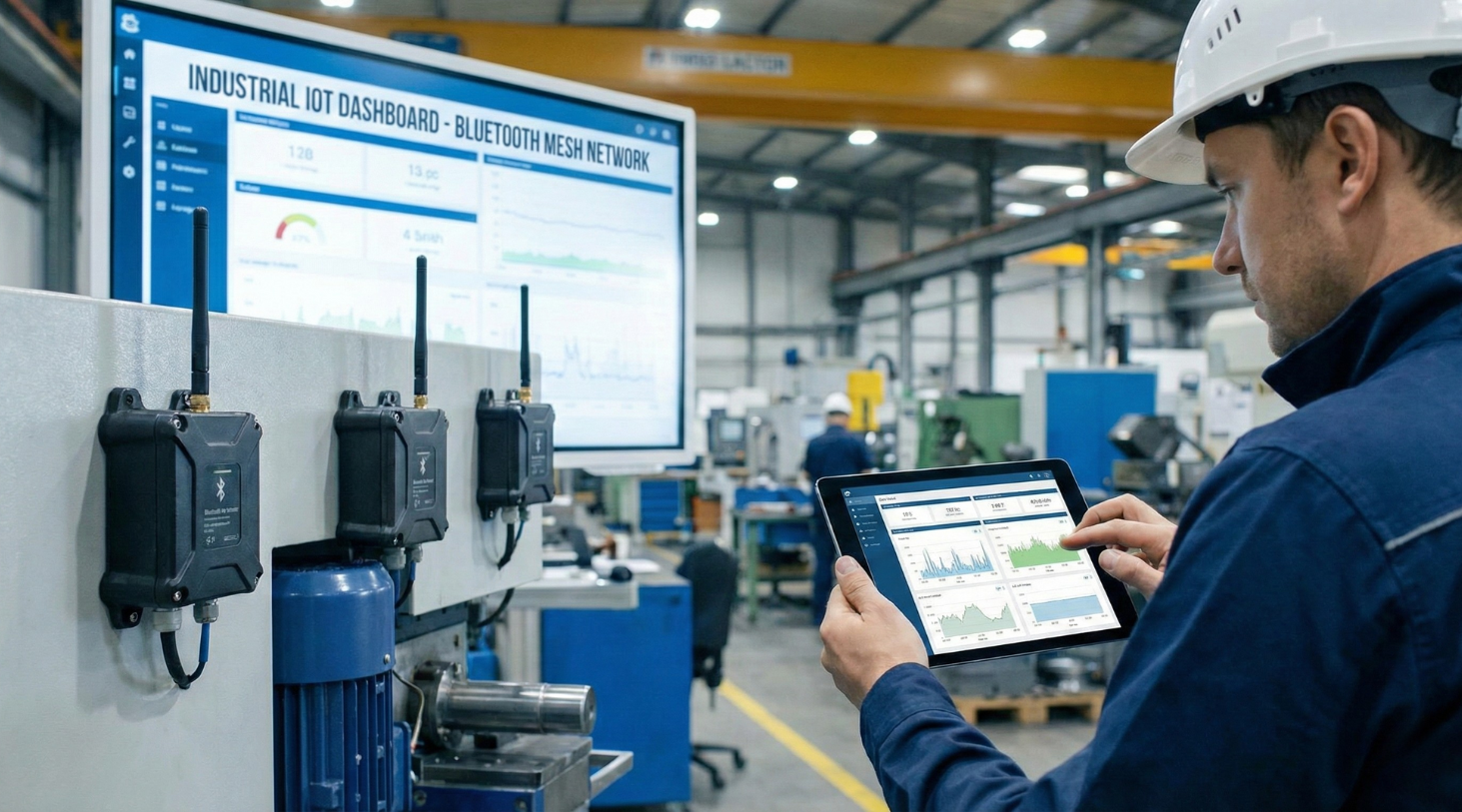
Asset tracking is often the first use case for manufacturing to move it from concept to production within modern Bluetooth IoT solutions. It solves a very concrete operational problem: precisely knowing where critical tools and equipment are at the instant they are needed on the shop floor.
Asset tracking as an Operational Layer, not just location data
In practice, Bluetooth asset tracking rarely unfolds as a stand-alone feature. It turns into an important part of a greater operational layer, tying physical assets to manufacturing workflows.
The following are some of the most important factors that a manufacturer usually focuses on to track:
-
high-value or calibrated tools;
-
mobile equipment shared between lines of production;
-
assets whose availability directly influences production throughput.
This selective approach keeps it lightweight while still delivering real value.
From Raw Signals to Usable Manufacturing Insights
The difference in industrial asset tracking, as opposed to mere beacon detection, lies in how the data is processed. Using a cloud backend, raw Bluetooth events are turned into actionable insights:
-
confirmation that all the required tools will be available before the shift commences;
-
alerts when equipment leaves approved zones;
-
utilisation reports showing bottlenecks and idle assets.
Here, asset tracking ceases to be about where something is and begins answering how assets are actually used.
Example: Bluetooth Asset Tracking as Part of a SaaS Platform
In an average manufacturing plant with several lines and standardised equipment, before the implementation of Bluetooth tracking, employees spent valuable time searching for equipment or holding off on their activities.
After deploying asset tracking solutions as part of a custom SaaS dev project:
-
The critical tools were also labelled and tracked in real time.
-
The supervisors could gain “immediate visibility” using a web dashboard.
-
The number of duplicated asset purchases was decreased through the use of insights from utilisation.
Since the implementation was developed with a full-cycle approach to software development, it was possible to deploy the same model for asset tracking at another plant without having to rebuild the system.
Why Asset Tracking Fits Naturally into Full-Cycle Industrial Solutions
The result with asset tracking is very immediate, as it seamlessly integrates with the current workflow. Done properly by a product team, this can expand:
-
Starting with a focused SaaS MVP only.
-
Expanding to multi-site deployments.
-
Later, it may serve for maintenance planning or enforcing safety.
That's why asset tracking is often the entry point in broader industrial Bluetooth IoT solutions: practical, scalable, and very much aligned with real needs in manufacturing.
Predictive Maintenance with Bluetooth IoT Sensors in Industrial Environments
Unexpected failures in production remain one of the costliest risks in modern manufacturing. A predictive maintenance solution provided via IoT meets this need by allowing manufacturers to switch from scheduled maintenance to data-driven decision-making. Using SaaS-based application development, predictive maintenance transforms into an ever-improving solution.
Bluetooth Sensors as a Data Source for Industrial Predictive Maintenance
Bluetooth-based predictive maintenance uses low-power sensors mounted on equipment to measure vibration, temperature, and operating cycles. This approach works best in industrial settings where energy efficiency and long device life matter.
In predictive maintenance, data is streamed to a cloud backend platform, where it is stored and analysed.
Machinery Health Monitoring Powered by a SaaS Analytics Layer
The value of machinery health monitoring emerges only at the analytics level. Predictive maintenance IoT platforms analyse time-series data to identify the trends leading to degradation, rather than sending single alerts.
Using cloud analytics with an engine developed through SaaS software development services, manufacturers gain:
-
baseline models of normal machine behaviour;
-
early detection of abnormal vibration or thermal patterns;
-
predictive alerts that are generated before failures occur.
Model improvement is continuous, as the analytics logic lives in the SaaS layer and more data gets collected across machines, lines, and facilities.
Example: SaaS-Based Predictive Maintenance in a Manufacturing Plant
Let’s take the case of a manufacturing unit that has several CNC machines operating at varying capacities. Conventionally, the maintenance of all these machines was performed based on time intervals.
After the implementation of the predictive maintenance IoT, there have been the following benefits:
-
The Bluetooth sensors were used to set the baseline behaviours of the machines.
-
The platform detected deviations weeks before an actual machine failure.
-
The alerts for maintenance work were based on risk rather than time.
This led to a decrease in emergency repairs and the prioritisation of high-risk machines by the maintenance team. Because the system was built with the SaaS model in mind, the prediction system was reused in a different facility with similar equipment.
Predictive Maintenance as a Full-Cycle SaaS Capability
Unlike a point monitoring system, predictive maintenance benefits from long-term evolution. When the platform is built by a SaaS platform team, it can:
-
start with a focused SaaS MVP;
-
more analytics depth by expanding historical data;
-
gradually integrate with ERP or maintenance systems.
That's why industrial predictive maintenance for manufacturers is increasingly treated as part of a wider SaaS strategy, rather than isolated sensor deployments.
How Predictive Maintenance Fits into Bluetooth IoT Solutions
Within comprehensive Bluetooth IoT solutions, predictive maintenance is an additional layer of reliability and performance. Asset tracking is about showing where the equipment is; predictive maintenance shows how it is performing and when intervention will be required.
Combined with Bluetooth sensors, manufacturers develop a scalable SaaS platform built by an experienced SaaS team that provides them with long-term data-driven maintenance capabilities, reducing downtime and improving safety while supporting sustainable industrial growth.
Worker Safety and Wearables: Bluetooth IoT for Location and Condition Monitoring
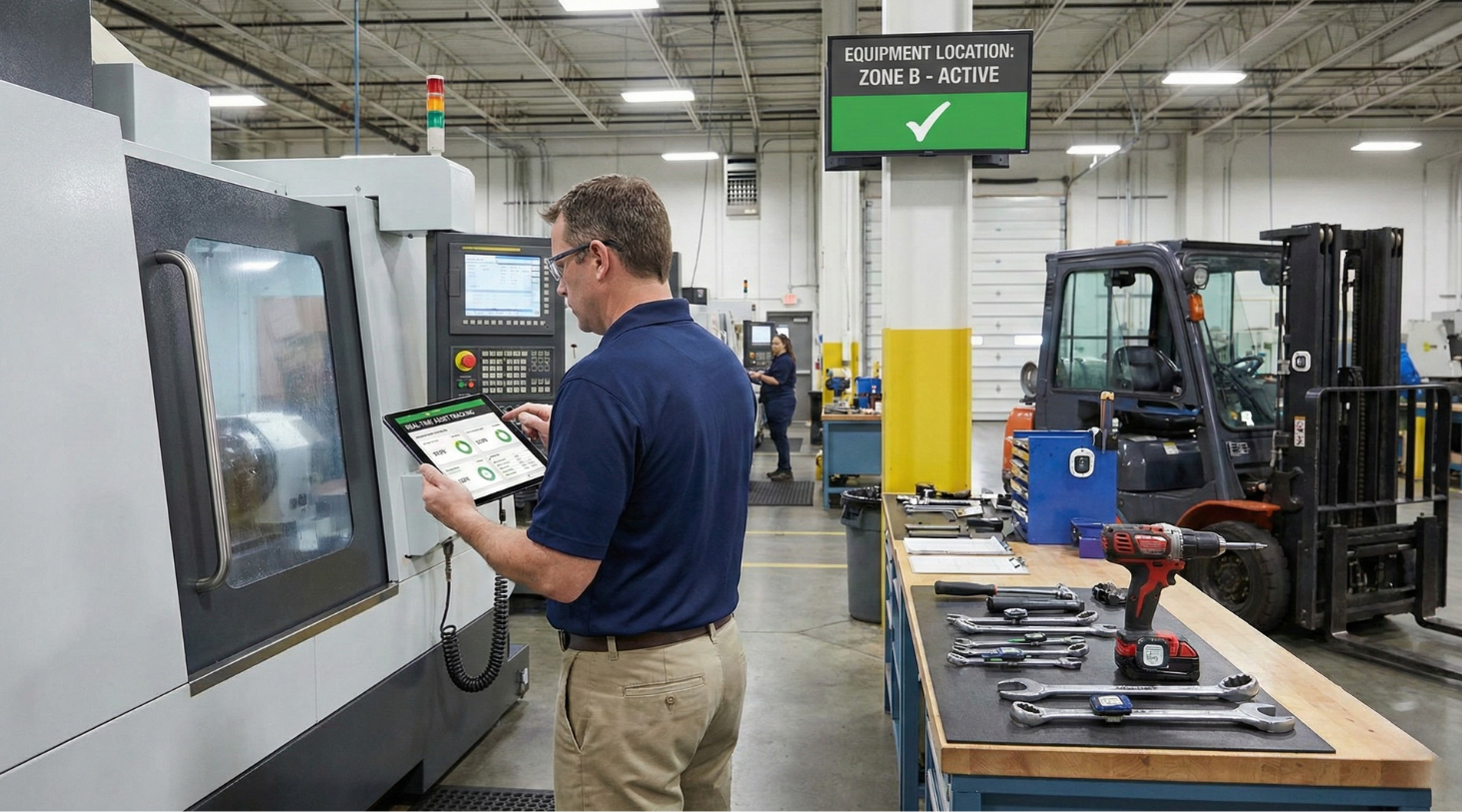
Regarding the operational context of the industry, the solution for worker safety needs to operate reliably and in real-time, while also integrating seamlessly into existing processes. Worker safety, from an engineering perspective, has been enhanced through the use of BLE wearables, indoor zone detection, and SaaS-based rules and analytics.
BLE Wearables as the Foundation of Safety Monitoring
To address safety on the device level, worker safety is associated with Bluetooth-enabled wearables in the form of a badge, wristband, or tag on a helmet. These devices periodically broadcast identifiers and basic telemetry, including signal strength, motion state, and device health indicators.
In the context of industrial safety, the suitability of the Low-Energy version of the technology can be attributed to the following reasons:
-
stable indoor signal propagation;
-
low power consumption during full shift operation;
-
predictable behaviour in controlled factory environments.
Wearables only serve as signal emitters. All safety-related logic is deliberately shifted out of the wearable and executed at the SaaS level.
Zone-Based Location Detection Instead of Precise Positioning
Precise indoor positioning is rarely needed for worker safety use cases. Instead, zone-based detection is focused on by industrial Bluetooth IoT solutions, which are simpler, more reliable, and easier to maintain.
Technically, this involves:
-
BLE signals are collected via fixed gateways or edge devices.
-
Filtering RSSI values to reduce interference and false positives.
This determines worker presence in predefined zones.
These transitions are emitted as structured events and processed in near real-time by the backend. All this without complex triangulation, yet sufficient to enforce all sorts of safety policies.
Safety Logic Implemented in the SaaS Layer
The core intelligence in worker safety systems sits at the SaaS backend, where Bluetooth events are evaluated against configurable safety rules, such as:
-
Unauthorised entry to restricted areas.
-
The excessive dwell time in hazardous areas.
-
Prolonged inactivity during active shifts.
Each rule evaluation generates an auditable event that can trigger alerts, notifications, or incident records. Since all that logic sits centrally, safety policies can be updated without redeploying devices or updating firmware.
Monitoring Worker Condition Without Collecting Sensitive Data
From a technical and regulatory point of view, the collection of personal data should be minimised in industrial safety systems. As opposed to biometric supervision, the so-called Bluetooth IoT technology infers worker status from the following indirect signals:
-
motion versus inactivity patterns;
-
abnormal zone transition frequency;
-
extended exposure to physically demanding environments.
These signals are usually enough to detect risk while keeping data collection minimal.
Example: SaaS-Based Worker Safety in a Manufacturing Facility
In a multi-zone manufacturing environment with limited areas for performing maintenance, the BLE safety badges were used by the workers. The fixed gateway was placed in the zones, and the safety logic was designed in the SaaS system.
When an employee tried to enter an area without the necessary approval, the system issued an alert in seconds. Staying in high-risk areas led to escalation alerts, which could be seen on the web dashboard by the supervisor. Inactivity in an active session triggered alerts for potential incidents.
With time, event data aggregation showed certain safety hazards were associated with certain areas and times. This kind of data was useful for optimising schedules and restrictions based on operations, with no changes to the layout or hardware configuration.
Because the platform was built as SaaS, the same safety model could be reused in other facilities by reconfiguring zones and rules.
Scaling Worker Safety Through Full-Cycle SaaS Development
When implemented by an engineering team, scalability has predictable and maintainable characteristics:
-
New zones added through configuration.
-
“Additional facilities” reuse the same backend and data model.
-
Integrations with systems related to compliance, human resources, or incident management occur through the use of APIs.
Through the full-cycle development of web-based application software, the issue of worker safety evolves into a dynamic performance capability rather than a static regulatory function.
Worker Safety as a Core Component of Industrial Bluetooth IoT Solutions
Within an overall industrial IoT platform:
-
Asset tracking gives insight into physical resources.
-
Predictive maintenance ensures the reliability of equipment.
-
Worker safety enables controlled and monitored human interaction with industrial conditions.
With all these layers, the Bluetooth IoT offers a unified solution that addresses official operational procedures, government laws, and long-term sustainability at the production level.
Building an Industrial Bluetooth IoT SaaS Platform: Architecture, Steps, and Budget
The true benefits of the industrial-grade Bluetooth IoT platform can only be realised by having scalable SaaS offerings, but not pilot projects. That requires a delivery roadmap and a realistic budget from the start.
Below is a practical step-by-step roadmap a full-cycle software team can follow, with typical timelines and budgets.
Step 1: Discovery, Use-Case Definition, and SRS
In every industrial Bluetooth IoT implementation, the process necessarily involves a harmonisation phase where technology meets the needs of the operations. In the development phase of this process, the software partner will necessarily work with other departments: engineering, operations, and safety teams.
Key Outputs:
-
Use cases: asset tracking, predictive maintenance, worker safety & site awareness.
-
Data sources: BLE tags, sensors, wearables, gateways.
-
Example event flows: what happens when a machine overheats, an asset moves, or a worker enters a restricted zone.
-
Integration Map: ERP, CMMS, EHS, Business Intelligence Solutions.
-
Non-functional requirements: latency, availability, data retention, and security requirements.
All of the above are formalised in the Software Requirement Specification (SRS), a document that serves as the technical blueprint for the subsequent phases.
Typical timeline: 2-4 weeks
Budget: $5,000 - $10,000
This phase is usually delivered as part of custom SaaS development services and prevents costly redesigns later.
Step 2: SaaS MVP for Industrial Bluetooth IoT
The subsequent stage of developing the MVP of the SaaS solution is to verify the actual data flows that might occur in one to two facilities.
Generally, MVP includes the following elements:
-
Ingestion of BLE Devices (tags, sensors, wearables);
-
Event processing backend: cloud-based, scalable;
-
Basic business rules for one or two use cases (tracking resources + notifications for basic maintenance);
-
Dashboard design for operation and maintenance teams;
-
One key integration (CMMS or ERP).
At this point, the system is already designed and architected as a cloud-based software as a service (SaaS) that is multi-tenant-ready.
Timeline: 3-4 months
Budget: $35,000 - $60,000
Step 3: Scaling to a Full Industrial SaaS Platform
Eventually, the platform is scaled up from an MVP to an industrial-grade SaaS offering after it has proven successful in its initial environment.
It might include the following:
-
Multi-tenancy hardening (plants, business units, external clients).
-
Applications of Advanced Analytics for IoT-based Predictive Maintenance.
-
Worker safety rule engines (geofencing and condition monitoring).
-
Further Integrations (ERP, EHS, BI, Data Lakes).
-
Role-Based Access Control & Audit Logs.
-
SLA monitoring and observability.
Timeline: 6-9 months (iterative)
Budget: $100,000 - $200,000
This is where SaaS product development services provide the most long-term value.
Step 4: Ongoing Operations and Platform Evolution
An industrial Bluetooth IoT platform is never “done” in reality. Once it has been implemented, an industrial Bluetooth IoT platform becomes a living system.
Ongoing investment normally includes:
-
Cloud infrastructure and monitoring
-
Onboarding support for sensor and gateway
-
Feature iteration with operational feedback
-
Security patches and regulatory obligations
-
Handling growing volumes of data
Performance optimisation in a growing environment. Usually, this phase can be completed by forming a relationship with a full-cycle software development company.
Monthly budget: $2,000 - $5,000
(depending on scale, data volume, and roadmap)
Example Budget: Mid-Sized Manufacturing Company
Scenario:
-
2 production plants;
-
~500 assets and machines;
-
BLE sensors for vibration & temperature;
-
Wearables for worker safety;
-
ERP + CMMS integrations.
| Phase | Scope | Budget |
|---|---|---|
| Discovery & SRS | Architecture, integrations, use cases | $20,000 |
| SaaS MVP | Asset tracking + basic maintenance | $80,000 |
| Full SaaS Platform | Predictive maintenance + safety | $150,000 |
| Ongoing Ops | Cloud + evolution | $10,000 / month |
Total initial investment: ~$250,000
Result: A scalable industrial Bluetooth IoT SaaS platform ready for multi-site rollout.
Why Full-Cycle SaaS Development Is Critical
Industrial Bluetooth IoT platforms touch core business operations. Building them out in piecemeal teams or one-off implementations leads to brittle systems and technical debt.
An engineering team makes sure that:
-
architecture that scales with operations;
-
integrations that survive system changes;
-
analytics that evolve without hardware rewrites;
-
predictable costs and delivery milestones.
This is the exact model Join.To.IT applies when building industrial Bluetooth IoT solutions: from SRS and SaaS MVP to production-grade platforms that support asset tracking, predictive maintenance, and worker safety within a single, extensible SaaS ecosystem.
Business Impact and ROI of Industrial Bluetooth IoT Solutions
An industrial Bluetooth IoT offering is valuable only if it can provide measurable business results starting from raw data. On becoming a scalable SaaS offering, Bluetooth IoT can significantly impact costs, efficiency, security, and scalability.
Here are the main sectors in which the returns can be seen in an actual industrial setup.
Reduced Downtime and Maintenance Costs
One of the quickest and most tangible payoffs is in the domain of predictive maintenance IoT.
Rather than reacting to failure:
-
These Bluetooth sensors are continuously monitoring vibrations, temperatures, and usage.
-
SaaS analytics allow early identification of anomalies before failures happen.
-
Maintenance will move from reactive repairs towards planned intervention.
Typical impact:
-
15-30% reduction in unplanned downtime.
-
Reduced spare part inventory levels because of predictable maintenance cycles.
-
Fewer production shutdowns and overtime costs.
Where production facilities will incur costs measured in thousands of dollars per hour of downtime, small changes yield quick returns on investment.
Higher Asset Utilisation and Capital Efficiency
Bluetooth asset tracking enables the company to know at any time the location, usage rate, or location where the asset spends most of its time.
This allows:
-
Identification of underutilised tools and machines;
-
Avoiding unnecessary purchases of equipment;
-
Rapid identification of vital assets in peak operations.
Business result:
-
Improving return on existing capital assets;
-
Reduce CapEx spending by reusing rather than expanding;
-
More accurate production planning based upon real market usage.
Asset visibility, as such, provides sufficient reason to invest in Bluetooth IoT solutions within the first year.
Improved Worker Safety and Lower Risk Exposure
Worker safety use cases are rarely gauged in monetary value, despite having significant dollar ramifications.
Bluetooth-enabled wearables and zone-based surveillance systems are beneficial:
-
Intrusion detection in restricted and dangerous zones;
-
Track worker presence during emergencies;
-
Monitor exposure to hazardous environmental elements.
ROI drivers:
-
Fewer events and safety violations;
-
Minimised risks of insurance and compliance;
-
Reduced costs due to accidents, investigation, and lost time.
In highly regulated sectors, for example, the return on investment for safety may be higher than that for operations.
Operational Transparency Across Sites and Teams
When Bluetooth IoT is hosted on a multi-tenant SaaS platform, it provides a common visibility experience for plant, shift, and regional managers.
Executives and operations leaders can:
-
Compare performance across facilities.
-
Analyse Bottlenecks and Best Practices.
-
Make the process standardised without mandating the same hardware configuration.
The transparency level makes it possible to make data-driven decisions rather than making decisions in multi-site industrial companies.
Scalable Growth Without Linear Cost Increase
One of the most underestimated benefits that comes with SaaS-based Bluetooth IoT platforms is non-linear scaling.
Once the platform is in place:
-
Adding new machines, workers, or facilities becomes configuration-driven.
-
Analytics and integrations scale without rebuilding the system.
-
New use cases, such as energy monitoring, compliance tracking, leverage the same architecture.
This allows industrial companies to scale-up operations without corresponding increases in IT complexity or headcount.
From Technology Investment to Strategic Advantage
This is not about short-term cost reduction - it is the true ROI of an industrial Bluetooth IoT solution. With industrial Bluetooth IoT in manufacturing, companies can scale asset tracking, predictive maintenance, and safety workflows through one SaaS platform.
Over time, the platform becomes a strategic asset:
-
A growing dataset for advanced analytics and AI;
-
A foundation for automation and optimisation initiatives;
-
A reusable product SaaS, which can be used by partners or external customers.
In the case of development, Bluetooth IoT solutions will be developed with the business without becoming legacy systems.
Where Join.To.IT Fits
At Join.To.IT, we develop industrial Bluetooth IoT solutions not in terms of hardware development, but in terms of a SaaS product on a longer-term basis.
We assist enterprises in:
-
Specify ROI-driven use cases at the SRS level.
-
Develop scalable SaaS MVPs that validate in real-world production scenarios.
-
Leverage developments in platforms to create enterprise-class solutions for asset tracking, predictive maintenance and employee safety.
-
The platform must remain secure, maintainable, and scalable.
The result is not only improved operations but also the creation of business advantage through data and full-cycle software engineering.